Dichlorvos
Dichlorvos or 2,2-dichlorovinyl dimethyl phosphate (commonly abbreviated as an DDVP) is a organophosphate, developed during the early 1960s as an insecticide, and a parasiticide for pets.
History[edit]
Dichlorvos was developed by Shell Development Company in the 1960s following the discovery of the insecticidal properties of organophosphates during the 1930s and 1940s.
Uses[edit]
Dichlorvos is used to control household pests, in public health, and for protection of stored product from insects. It is used on crops, animals, and in pest-strips.
Mechanism of action[edit]
Dichlorvos works by inhibiting acetylcholinesterase, an enzyme necessary for normal nerve impulse transmission, resulting in excess acetylcholine at the sites of neurotransmission, causing persistent depolarization of the postsynaptic membrane.
Health effects[edit]
Exposure to dichlorvos can cause nausea, diarrhea, increased heart rate, and in severe cases, can cause death. Chronic exposure can cause a delayed neuropathy.
Environmental effects[edit]
Dichlorvos is toxic to birds and fish, and is also toxic to bees.
See also[edit]
References[edit]

This WikiMD article can only be edited by registered and verified editors. You can log in or register.
-
 Structural formula of Dichlorvos
 -
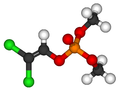 3D model of Dichlorvos
 -
 Gold medal awarded to Kelvin


Medical Disclaimer: WikiMD is for informational purposes only and is not a substitute for professional medical advice. Content may be inaccurate or outdated and should not be used for diagnosis or treatment. Always consult your healthcare provider for medical decisions. Verify information with trusted sources such as CDC.gov and NIH.gov. By using this site, you agree that WikiMD is not liable for any outcomes related to its content. See full disclaimer.
Credits:Most images are courtesy of Wikimedia commons, and templates, categories Wikipedia, licensed under CC BY SA or similar.
Translate page: - East Asian
中文,
日本,
한국어,
South Asian
हिन्दी,
தமிழ்,
తెలుగు,
Urdu,
ಕನ್ನಡ,
Southeast Asian
Indonesian,
Vietnamese,
Thai,
မြန်မာဘာသာ,
বাংলা
European
español,
Deutsch,
français,
Greek,
português do Brasil,
polski,
română,
русский,
Nederlands,
norsk,
svenska,
suomi,
Italian
Middle Eastern & African
عربى,
Turkish,
Persian,
Hebrew,
Afrikaans,
isiZulu,
Kiswahili,
Other
Bulgarian,
Hungarian,
Czech,
Swedish,
മലയാളം,
मराठी,
ਪੰਜਾਬੀ,
ગુજરાતી,
Portuguese,
Ukrainian

