Dehydrohalogenation
Dehydrohalogenation is a chemical reaction that involves the elimination of a halogen atom and a hydrogen atom in an organic compound. This reaction is a subtype of elimination reactions and is a vital process in organic chemistry.
Mechanism[edit]
The mechanism of dehydrohalogenation involves the formation of a carbanion or a carbene. The reaction proceeds via an E2 mechanism or an E1 mechanism, depending on the nature of the halogenoalkane.
In an E2 mechanism, the reaction is concerted. The base abstracts the proton on the β-carbon atom, leading to the formation of a double bond and the expulsion of the halogen atom.
In an E1 mechanism, the reaction proceeds in two steps. First, the halogen atom leaves, forming a carbocation. Then, a base abstracts a proton from the β-carbon atom, forming a double bond.
Factors affecting Dehydrohalogenation[edit]
Several factors affect the rate and the outcome of dehydrohalogenation. These include the strength of the base, the nature of the halogenoalkane, and the temperature.
Applications[edit]
Dehydrohalogenation is used in the synthesis of alkenes from halogenoalkanes. It is also used in the production of vinyl halides, which are used in the manufacture of polymers.
See also[edit]
References[edit]

 | This medical article is a stub. You can help WikiMD by expanding the page. |
-
Synthesis of alkenes - Dehydrohalogenation
-
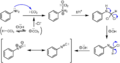 Carbylamine mechanism


Medical Disclaimer: WikiMD is for informational purposes only and is not a substitute for professional medical advice. Content may be inaccurate or outdated and should not be used for diagnosis or treatment. Always consult your healthcare provider for medical decisions. Verify information with trusted sources such as CDC.gov and NIH.gov. By using this site, you agree that WikiMD is not liable for any outcomes related to its content. See full disclaimer.
Credits:Most images are courtesy of Wikimedia commons, and templates, categories Wikipedia, licensed under CC BY SA or similar.
Translate page: - East Asian
中文,
日本,
한국어,
South Asian
हिन्दी,
தமிழ்,
తెలుగు,
Urdu,
ಕನ್ನಡ,
Southeast Asian
Indonesian,
Vietnamese,
Thai,
မြန်မာဘာသာ,
বাংলা
European
español,
Deutsch,
français,
Greek,
português do Brasil,
polski,
română,
русский,
Nederlands,
norsk,
svenska,
suomi,
Italian
Middle Eastern & African
عربى,
Turkish,
Persian,
Hebrew,
Afrikaans,
isiZulu,
Kiswahili,
Other
Bulgarian,
Hungarian,
Czech,
Swedish,
മലയാളം,
मराठी,
ਪੰਜਾਬੀ,
ગુજરાતી,
Portuguese,
Ukrainian


