Deep cerebellar nuclei
The Deep Cerebellar Nuclei (DCN) are clusters of neurons, or nerve cells, located within the white matter of the cerebellum. These nuclei serve as the primary output system of the cerebellum, sending signals to various parts of the brain and spinal cord.
Anatomy[edit]
The deep cerebellar nuclei consist of four pairs of nuclei, named according to their relative positions within the cerebellum. These are the Fastigial nucleus, the Globose nucleus, the Emboliform nucleus, and the Dentate nucleus. Each of these nuclei has a unique structure and function, and they all play a crucial role in the overall function of the cerebellum.
Function[edit]
The deep cerebellar nuclei receive input from the Purkinje cells of the cerebellar cortex and send output to various parts of the brain and spinal cord. This output is primarily inhibitory, meaning it reduces the activity of the target neurons. The specific functions of the deep cerebellar nuclei depend on the particular nucleus and its connections.
Clinical Significance[edit]
Damage to the deep cerebellar nuclei can result in a variety of neurological disorders, including ataxia, dysmetria, and tremor. These conditions can significantly impact a person's ability to move and coordinate their movements.
See Also[edit]
References[edit]

This WikiMD article can only be edited by registered and verified editors. You can log in or register.
Deep_cerebellar_nuclei[edit]
-
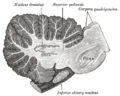 Deep cerebellar nuclei
 -
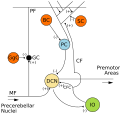 Diagram of the microanatomy of human cerebellar cortex
 -
Deep cerebellar nuclei
-
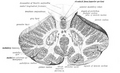 Deep cerebellar nuclei


Medical Disclaimer: WikiMD is for informational purposes only and is not a substitute for professional medical advice. Content may be inaccurate or outdated and should not be used for diagnosis or treatment. Always consult your healthcare provider for medical decisions. Verify information with trusted sources such as CDC.gov and NIH.gov. By using this site, you agree that WikiMD is not liable for any outcomes related to its content. See full disclaimer.
Credits:Most images are courtesy of Wikimedia commons, and templates, categories Wikipedia, licensed under CC BY SA or similar.
Translate page: - East Asian
中文,
日本,
한국어,
South Asian
हिन्दी,
தமிழ்,
తెలుగు,
Urdu,
ಕನ್ನಡ,
Southeast Asian
Indonesian,
Vietnamese,
Thai,
မြန်မာဘာသာ,
বাংলা
European
español,
Deutsch,
français,
Greek,
português do Brasil,
polski,
română,
русский,
Nederlands,
norsk,
svenska,
suomi,
Italian
Middle Eastern & African
عربى,
Turkish,
Persian,
Hebrew,
Afrikaans,
isiZulu,
Kiswahili,
Other
Bulgarian,
Hungarian,
Czech,
Swedish,
മലയാളം,
मराठी,
ਪੰਜਾਬੀ,
ગુજરાતી,
Portuguese,
Ukrainian


