Daifuku
Daifuku (大福) is a traditional Japanese confectionery that is often served with green tea. It is a type of mochi, a sweet, chewy rice cake, that is typically filled with anko, a sweet red bean paste. The name "daifuku" translates to "great luck" in English, reflecting the belief that these sweets bring good fortune.
History[edit]
The origins of daifuku can be traced back to the Heian period (794-1185), when mochi was a luxury item enjoyed by the nobility. The practice of filling mochi with sweet fillings began during the Muromachi period (1336-1573). The term "daifuku" was first used during the Edo period (1603-1868), reflecting the prosperity of the time.
Preparation[edit]
Daifuku is made by first preparing the mochi. Glutinous rice is soaked overnight, then steamed and pounded until it forms a smooth, elastic dough. This dough is then divided into small portions, which are flattened and filled with anko. The filled mochi is then pinched closed and dusted with potato starch to prevent sticking.
There are many variations of daifuku, including strawberry daifuku, which includes a whole strawberry inside the mochi, and yomogi daifuku, which is made with mochi that has been flavored and colored with yomogi (Japanese mugwort).
Cultural Significance[edit]
Daifuku is often enjoyed during traditional tea ceremonies, and is also a popular gift for special occasions and celebrations. It is also commonly sold at festivals and by street vendors.
See Also[edit]
 | This Japanese dessert-related article is a stub. You can help WikiMD by expanding the page. |

-
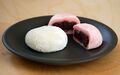 Daifuku
 -
 Daifuku
 -
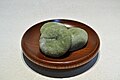 Yomogi Daifuku
 -
 Soft rice cake stuffed with sweetened bean & strawberry


Medical Disclaimer: WikiMD is for informational purposes only and is not a substitute for professional medical advice. Content may be inaccurate or outdated and should not be used for diagnosis or treatment. Always consult your healthcare provider for medical decisions. Verify information with trusted sources such as CDC.gov and NIH.gov. By using this site, you agree that WikiMD is not liable for any outcomes related to its content. See full disclaimer.
Credits:Most images are courtesy of Wikimedia commons, and templates, categories Wikipedia, licensed under CC BY SA or similar.
Translate page: - East Asian
中文,
日本,
한국어,
South Asian
हिन्दी,
தமிழ்,
తెలుగు,
Urdu,
ಕನ್ನಡ,
Southeast Asian
Indonesian,
Vietnamese,
Thai,
မြန်မာဘာသာ,
বাংলা
European
español,
Deutsch,
français,
Greek,
português do Brasil,
polski,
română,
русский,
Nederlands,
norsk,
svenska,
suomi,
Italian
Middle Eastern & African
عربى,
Turkish,
Persian,
Hebrew,
Afrikaans,
isiZulu,
Kiswahili,
Other
Bulgarian,
Hungarian,
Czech,
Swedish,
മലയാളം,
मराठी,
ਪੰਜਾਬੀ,
ગુજરાતી,
Portuguese,
Ukrainian

