Cytidine
Cytidine is a nucleoside molecule that is formed when cytosine is attached to a ribose ring (also known as a ribofuranose) via a β-N1-glycosidic bond.
Chemical Structure[edit]
Cytidine is composed of a pyrimidine base, specifically cytosine, and a pentose sugar, ribose. The chemical formula of cytidine is C9H13N3O5.
Biological Role[edit]
Cytidine plays a crucial role in a number of biological processes. It is a component of RNA, where it pairs with guanine. In addition, cytidine is involved in the regulation of enzymes and in the production of phospholipids.
Synthesis and Degradation[edit]
Cytidine is synthesized in the body through the salvage pathway. This process involves the recycling of nucleotides from degraded RNA and DNA. Cytidine can also be degraded in the body to produce uridine, which can then be converted to uracil.
Clinical Significance[edit]
Cytidine has been studied for its potential therapeutic uses. For example, cytidine analogs have been used in the treatment of certain types of cancer. In addition, cytidine may have neuroprotective effects and has been studied in the context of neurodegenerative diseases.
See Also[edit]
- Nucleoside
- Cytosine
- Ribose
- RNA
- Guanine
- Enzyme
- Phospholipid
- Salvage pathway
- Uridine
- Uracil
- Cancer
- Neurodegenerative disease

This WikiMD article can only be edited by registered and verified editors. You can log in or register.
Cytidine[edit]
-
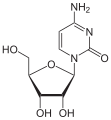 Cytidin.svg
 -
Cytidine 3D ball

Advertise on WikiMD — 81,000+ full articles, ~900,000 total pages, ~250 million page views. Global reach, limited time promotional rates from $1/page/day. Learn more · View stats

Translate page: - East Asian
中文,
日本,
한국어,
South Asian
हिन्दी,
தமிழ்,
తెలుగు,
Urdu,
ಕನ್ನಡ,
Southeast Asian
Indonesian,
Vietnamese,
Thai,
မြန်မာဘာသာ,
বাংলা
European
español,
Deutsch,
français,
Greek,
português do Brasil,
polski,
română,
русский,
Nederlands,
norsk,
svenska,
suomi,
Italian
Middle Eastern & African
عربى,
Turkish,
Persian,
Hebrew,
Afrikaans,
isiZulu,
Kiswahili,
Other
Bulgarian,
Hungarian,
Czech,
Swedish,
മലയാളം,
मराठी,
ਪੰਜਾਬੀ,
ગુજરાતી,
Portuguese,
Ukrainian
About WikiMD • Contact • Disclaimer • Privacy • Copyright • Site statistics
Some content and images may originate from Wikimedia Commons or Wikipedia and remain subject to their stated licenses. Unless otherwise noted, eligible WikiMD content is available under CC BY-SA 4.0.
WikiMD Wellnesspedia — Free health & wellness information for patients, students, and health professionals.


