Crown ether
Crown ether refers to a family of cyclic chemical compounds consisting of a ring containing several ether groups. These compounds are named for their structure, which resembles a crown, and their ability to selectively bind certain cations, such as potassium, sodium, and calcium, through a process known as complexation. Crown ethers are notable for their applications in organic chemistry, particularly in the field of host-guest chemistry, where they act as hosts for the guest cations.
Structure and Classification[edit]
Crown ethers are characterized by their ring structure, which typically contains two or more oxygen atoms separated by methylene groups (-CH2-). The most common crown ethers are those that contain 12, 15, 18, or 21 atoms in the ring, including oxygen atoms. These are often referred to by the number of atoms in the ring followed by "crown" and the number of oxygen atoms. For example, an 18-crown-6 ether has 18 atoms in the ring, including 6 oxygen atoms.
Synthesis[edit]
The synthesis of crown ethers involves the formation of a ring containing ether linkages. One of the most common methods for synthesizing crown ethers is the Williamson ether synthesis, where a halogenated hydrocarbon reacts with a phenoxide ion. Another method involves the use of phase transfer catalysis, which can increase the efficiency of the reaction.
Mechanism of Action[edit]
Crown ethers function by binding to cations through their oxygen atoms, which act as electron pair donors. The size of the ether's cavity is crucial for its selectivity towards different cations. For instance, 18-crown-6 is particularly well-suited for complexing with potassium ions due to the size match between the ion and the ether's cavity. This selective binding is utilized in various chemical separations and syntheses.
Applications[edit]
Crown ethers have a wide range of applications in chemical research and industry. They are used in phase transfer catalysis, where they enhance the rate of reaction by increasing the solubility of inorganic salts in organic solvents. Crown ethers also play a crucial role in the synthesis of organic compounds, acting as protecting groups for cations or as catalysts in reactions. Additionally, their ability to selectively bind ions has led to their use in sensors and in the extraction and separation of metal ions.
Safety and Toxicology[edit]
While crown ethers are valuable tools in chemistry, they must be handled with care due to their potential toxicity. The safety measures and toxicological effects vary depending on the specific compound and its concentration. It is essential to consult material safety data sheets (MSDS) and adhere to laboratory safety protocols when working with these chemicals.

See Also[edit]
References[edit]
External Links[edit]
-
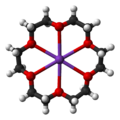 18-crown-6 potassium 3D balls
 -
 Various crown ethers (molecular diagrams)

.png)

Medical Disclaimer: WikiMD is for informational purposes only and is not a substitute for professional medical advice. Content may be inaccurate or outdated and should not be used for diagnosis or treatment. Always consult your healthcare provider for medical decisions. Verify information with trusted sources such as CDC.gov and NIH.gov. By using this site, you agree that WikiMD is not liable for any outcomes related to its content. See full disclaimer.
Credits:Most images are courtesy of Wikimedia commons, and templates, categories Wikipedia, licensed under CC BY SA or similar.
Translate page: - East Asian
中文,
日本,
한국어,
South Asian
हिन्दी,
தமிழ்,
తెలుగు,
Urdu,
ಕನ್ನಡ,
Southeast Asian
Indonesian,
Vietnamese,
Thai,
မြန်မာဘာသာ,
বাংলা
European
español,
Deutsch,
français,
Greek,
português do Brasil,
polski,
română,
русский,
Nederlands,
norsk,
svenska,
suomi,
Italian
Middle Eastern & African
عربى,
Turkish,
Persian,
Hebrew,
Afrikaans,
isiZulu,
Kiswahili,
Other
Bulgarian,
Hungarian,
Czech,
Swedish,
മലയാളം,
मराठी,
ਪੰਜਾਬੀ,
ગુજરાતી,
Portuguese,
Ukrainian

