Couching (ophthalmology)
Couching is an ancient method of cataract treatment that dates back to 2000 BC. The technique involves using a sharp instrument to dislodge the lens of the eye into the vitreous body, thereby clearing the pupil and restoring some degree of sight. Despite the high risk of complications and the availability of safer, more effective treatments, couching is still practiced in some parts of the world.
History[edit]
The earliest known reference to couching comes from the Code of Hammurabi, a Babylonian law code dating from around 1754 BC. The technique was also described in detail by the ancient Greek physician Hippocrates. Couching remained the primary treatment for cataracts until the 18th century, when modern cataract surgery techniques began to be developed.
Procedure[edit]
In a typical couching procedure, the patient is seated in a dark room. The surgeon uses a sharp instrument, such as a needle or a thorn, to puncture the sclera, the white part of the eye. The instrument is then used to push the cloudy lens out of the way, into the vitreous body. This clears the pupil and allows light to reach the retina, improving the patient's vision.
Risks and complications[edit]
Couching is associated with a high risk of complications, including endophthalmitis, retinal detachment, and glaucoma. Even when the procedure is successful, the patient's vision is usually poor, and they may still require glasses or contact lenses. In addition, the dislodged lens can cause inflammation and damage to the other structures of the eye.
Modern use[edit]
Despite the risks, couching is still practiced in some parts of the world, particularly in rural areas of Africa and Asia where access to modern medical care is limited. Efforts are being made to educate these communities about the dangers of couching and the benefits of modern cataract surgery.
See also[edit]
 | This medical article is a stub. You can help WikiMD by expanding the page. |
-
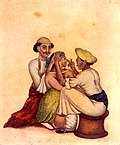 Couching for cataract.


Medical Disclaimer: WikiMD is for informational purposes only and is not a substitute for professional medical advice. Content may be inaccurate or outdated and should not be used for diagnosis or treatment. Always consult your healthcare provider for medical decisions. Verify information with trusted sources such as CDC.gov and NIH.gov. By using this site, you agree that WikiMD is not liable for any outcomes related to its content. See full disclaimer.
Credits:Most images are courtesy of Wikimedia commons, and templates, categories Wikipedia, licensed under CC BY SA or similar.
Translate page: - East Asian
中文,
日本,
한국어,
South Asian
हिन्दी,
தமிழ்,
తెలుగు,
Urdu,
ಕನ್ನಡ,
Southeast Asian
Indonesian,
Vietnamese,
Thai,
မြန်မာဘာသာ,
বাংলা
European
español,
Deutsch,
français,
Greek,
português do Brasil,
polski,
română,
русский,
Nederlands,
norsk,
svenska,
suomi,
Italian
Middle Eastern & African
عربى,
Turkish,
Persian,
Hebrew,
Afrikaans,
isiZulu,
Kiswahili,
Other
Bulgarian,
Hungarian,
Czech,
Swedish,
മലയാളം,
मराठी,
ਪੰਜਾਬੀ,
ગુજરાતી,
Portuguese,
Ukrainian

