Correlation
Correlation is a statistical measure that describes the degree to which two variables move in relation to each other. In the field of statistics, correlation is used to measure the strength and direction of the relationship between two variables.
Definition[edit]
Correlation is defined as the statistical relationship between two or more variables that change together, though not necessarily at the same rate. The correlation coefficient is a measure of the strength of this relationship. It is represented by the letter 'r' and can range from -1 to 1.
Types of Correlation[edit]
There are three types of correlation: positive, negative, and zero correlation.
- Positive Correlation: When the values of both variables increase or decrease together, the correlation is said to be positive.
- Negative Correlation: When the value of one variable increases while the other decreases, the correlation is said to be negative.
- Zero Correlation: When there is no relationship between the variables, the correlation is said to be zero.
Correlation vs Causation[edit]
It is important to note that correlation does not imply causation. Just because two variables correlate does not mean that one causes the other to occur. They may be related due to a third, unseen factor, known as a confounding variable.
Correlation in Medical Research[edit]
In medical research, correlation is used to determine if a relationship exists between two health-related variables, for example, smoking and lung cancer. This can help identify risk factors for diseases and guide public health interventions.
Calculating Correlation[edit]
The correlation between two variables can be calculated using the Pearson correlation coefficient formula. This formula takes into account the standard deviation and mean of both variables.
Limitations of Correlation[edit]
While correlation can indicate a possible relationship between two variables, it does not prove a cause-and-effect relationship. Correlation also cannot measure non-linear relationships, only linear ones.
See Also[edit]
 | This medical article is a stub. You can help WikiMD by expanding the page. |
-
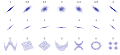 Scatter plots showing different types of correlation
 -
 Pearson Correlation Coefficient and associated scatterplots
 -
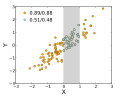 Correlation range dependence
 -
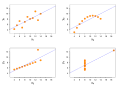 Anscombe's quartet


Medical Disclaimer: WikiMD is for informational purposes only and is not a substitute for professional medical advice. Content may be inaccurate or outdated and should not be used for diagnosis or treatment. Always consult your healthcare provider for medical decisions. Verify information with trusted sources such as CDC.gov and NIH.gov. By using this site, you agree that WikiMD is not liable for any outcomes related to its content. See full disclaimer.
Credits:Most images are courtesy of Wikimedia commons, and templates, categories Wikipedia, licensed under CC BY SA or similar.
Translate this page: - East Asian
中文,
日本,
한국어,
South Asian
हिन्दी,
தமிழ்,
తెలుగు,
Urdu,
ಕನ್ನಡ,
Southeast Asian
Indonesian,
Vietnamese,
Thai,
မြန်မာဘာသာ,
বাংলা
European
español,
Deutsch,
français,
Greek,
português do Brasil,
polski,
română,
русский,
Nederlands,
norsk,
svenska,
suomi,
Italian
Middle Eastern & African
عربى,
Turkish,
Persian,
Hebrew,
Afrikaans,
isiZulu,
Kiswahili,
Other
Bulgarian,
Hungarian,
Czech,
Swedish,
മലയാളം,
मराठी,
ਪੰਜਾਬੀ,
ગુજરાતી,
Portuguese,
Ukrainian
