Continuous murmurs
Continuous murmurs are a type of heart murmur that are audible throughout the entire cardiac cycle. They are often associated with certain types of congenital heart disease and vascular disease.
Definition[edit]
Continuous murmurs are defined as those that extend through both the systolic and diastolic phases of the cardiac cycle. They are continuous in nature, without a silent interval. This is in contrast to systolic murmurs, which occur only during the systole, and diastolic murmurs, which occur only during the diastole.
Causes[edit]
Continuous murmurs are often caused by abnormal connections between arteries and veins, known as arteriovenous fistulas. They can also be caused by certain types of congenital heart disease, such as patent ductus arteriosus (PDA) and ventricular septal defect (VSD). Other causes include aortic regurgitation, mitral regurgitation, and tricuspid regurgitation.
Diagnosis[edit]
Diagnosis of continuous murmurs is typically made through physical examination, specifically through auscultation of the heart. The murmur is often described as a "machinery" murmur due to its continuous nature. Further diagnostic tests, such as echocardiography, may be used to confirm the diagnosis and determine the underlying cause.
Treatment[edit]
Treatment of continuous murmurs depends on the underlying cause. In cases of congenital heart disease, surgery may be required to correct the defect. In cases of arteriovenous fistulas, treatment may involve embolization or surgical ligation. Medications may also be used to manage symptoms and prevent complications.
See also[edit]
- Heart murmur
- Congenital heart disease
- Vascular disease
- Arteriovenous fistula
- Patent ductus arteriosus
- Ventricular septal defect
- Aortic regurgitation
- Mitral regurgitation
- Tricuspid regurgitation
 | This cardiovascular system article is a stub. You can help WikiMD by expanding the page. |
 | This medical article is a stub. You can help WikiMD by expanding the page. |
-
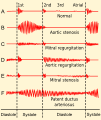 Phonocardiograms from normal and abnormal heart sounds


Medical Disclaimer: WikiMD is for informational purposes only and is not a substitute for professional medical advice. Content may be inaccurate or outdated and should not be used for diagnosis or treatment. Always consult your healthcare provider for medical decisions. Verify information with trusted sources such as CDC.gov and NIH.gov. By using this site, you agree that WikiMD is not liable for any outcomes related to its content. See full disclaimer.
Credits:Most images are courtesy of Wikimedia commons, and templates, categories Wikipedia, licensed under CC BY SA or similar.
Translate page: - East Asian
中文,
日本,
한국어,
South Asian
हिन्दी,
தமிழ்,
తెలుగు,
Urdu,
ಕನ್ನಡ,
Southeast Asian
Indonesian,
Vietnamese,
Thai,
မြန်မာဘာသာ,
বাংলা
European
español,
Deutsch,
français,
Greek,
português do Brasil,
polski,
română,
русский,
Nederlands,
norsk,
svenska,
suomi,
Italian
Middle Eastern & African
عربى,
Turkish,
Persian,
Hebrew,
Afrikaans,
isiZulu,
Kiswahili,
Other
Bulgarian,
Hungarian,
Czech,
Swedish,
മലയാളം,
मराठी,
ਪੰਜਾਬੀ,
ગુજરાતી,
Portuguese,
Ukrainian

