Collateral ligaments of metacarpophalangeal joints
Collateral ligaments of metacarpophalangeal joints are a set of ligaments found in the hand. They are located on either side of the metacarpophalangeal joint (MCP), which is the joint at the base of each finger. These ligaments play a crucial role in the stability and movement of the fingers.
Etymology[edit]
The term "collateral" is derived from the Latin word "collaterale," which means "side by side." "Ligament" comes from the Latin "ligamentum," meaning "a band." "Metacarpophalangeal" is a compound word made up of "metacarpus" (the part of the hand between the wrist and fingers) and "phalanges" (the bones of the fingers and toes).
Anatomy[edit]
The collateral ligaments of metacarpophalangeal joints are composed of two parts: the radial collateral ligament and the ulnar collateral ligament. These ligaments are named for their proximity to the radius and ulna, the two bones of the forearm.
The radial collateral ligament extends from the head of the metacarpal bone to the proximal phalanx on the thumb side of the hand. The ulnar collateral ligament extends from the head of the metacarpal bone to the proximal phalanx on the little finger side of the hand.
Function[edit]
The primary function of the collateral ligaments of metacarpophalangeal joints is to provide stability to the fingers during movement. They prevent excessive side-to-side movement of the fingers, which could lead to injury.
Related Terms[edit]
See Also[edit]

This WikiMD article can only be edited by registered and verified editors. You can log in or register.
Collateral ligaments of metacarpophalangeal joints[edit]
-
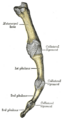 Collateral ligaments of metacarpophalangeal joints


Medical Disclaimer: WikiMD is for informational purposes only and is not a substitute for professional medical advice. Content may be inaccurate or outdated and should not be used for diagnosis or treatment. Always consult your healthcare provider for medical decisions. Verify information with trusted sources such as CDC.gov and NIH.gov. By using this site, you agree that WikiMD is not liable for any outcomes related to its content. See full disclaimer.
Credits:Most images are courtesy of Wikimedia commons, and templates, categories Wikipedia, licensed under CC BY SA or similar.
Translate page: - East Asian
中文,
日本,
한국어,
South Asian
हिन्दी,
தமிழ்,
తెలుగు,
Urdu,
ಕನ್ನಡ,
Southeast Asian
Indonesian,
Vietnamese,
Thai,
မြန်မာဘာသာ,
বাংলা
European
español,
Deutsch,
français,
Greek,
português do Brasil,
polski,
română,
русский,
Nederlands,
norsk,
svenska,
suomi,
Italian
Middle Eastern & African
عربى,
Turkish,
Persian,
Hebrew,
Afrikaans,
isiZulu,
Kiswahili,
Other
Bulgarian,
Hungarian,
Czech,
Swedish,
മലയാളം,
मराठी,
ਪੰਜਾਬੀ,
ગુજરાતી,
Portuguese,
Ukrainian

