Colby cheese
Colby cheese is a semi-hard American cheese originating from Colby, Wisconsin. It is made from cow's milk and is considered a washed-curd cheese, similar to Monterey Jack but with a milder flavor. Colby cheese was first created in 1885 by Joseph F. Steinwand at his cheese factory near Colby, Wisconsin. The cheese is named after the town where it was developed.
History[edit]
The development of Colby cheese in 1885 marked a significant contribution to the American cheese industry. Joseph F. Steinwand's innovation in cheese-making techniques led to the creation of a cheese that was distinct in both flavor and texture. The process of making Colby involves a technique known as "washing the curd," which reduces the cheese's acidity and results in a sweeter taste compared to more traditional cheeses.
Production[edit]
The production of Colby cheese involves the standard cheese-making process, with a few key differences. After the milk is pasteurized, cultures are added to start the fermentation process. The milk is then coagulated using rennet to form curds. These curds are cut, stirred, and then washed in fresh water, which lowers their acidity. After the washing process, the curds are pressed into molds and aged for one to two months. Unlike other cheeses, Colby does not undergo a long aging process, which contributes to its mild flavor profile.
Characteristics[edit]
Colby cheese is known for its soft, moist texture and its orange color, which comes from the addition of annatto. It has a mild to medium flavor that is slightly sweet and nutty. Colby can be used in a variety of culinary applications, including sandwiches, cheese platters, and as a melting cheese in cooked dishes.
Culinary Uses[edit]
Due to its mild flavor and ability to melt well, Colby cheese is popular in a variety of dishes. It is often used in grilled cheese sandwiches, on cheeseburgers, and in macaroni and cheese. It can also be found in salads, cheese trays, and as a snack paired with fruits and nuts.
See Also[edit]

```
-
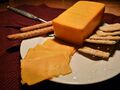 Colby cheese
 -
 Portrait of Joseph F. Steinwand
 -
 Original factory in Colby, Wisconsin
 -
 Cooking curds
 -
 Colby sign
 -
 CoJack cheese


.jpg)

Medical Disclaimer: WikiMD is for informational purposes only and is not a substitute for professional medical advice. Content may be inaccurate or outdated and should not be used for diagnosis or treatment. Always consult your healthcare provider for medical decisions. Verify information with trusted sources such as CDC.gov and NIH.gov. By using this site, you agree that WikiMD is not liable for any outcomes related to its content. See full disclaimer.
Credits:Most images are courtesy of Wikimedia commons, and templates, categories Wikipedia, licensed under CC BY SA or similar.
Translate page: - East Asian
中文,
日本,
한국어,
South Asian
हिन्दी,
தமிழ்,
తెలుగు,
Urdu,
ಕನ್ನಡ,
Southeast Asian
Indonesian,
Vietnamese,
Thai,
မြန်မာဘာသာ,
বাংলা
European
español,
Deutsch,
français,
Greek,
português do Brasil,
polski,
română,
русский,
Nederlands,
norsk,
svenska,
suomi,
Italian
Middle Eastern & African
عربى,
Turkish,
Persian,
Hebrew,
Afrikaans,
isiZulu,
Kiswahili,
Other
Bulgarian,
Hungarian,
Czech,
Swedish,
മലയാളം,
मराठी,
ਪੰਜਾਬੀ,
ગુજરાતી,
Portuguese,
Ukrainian

