Chinese desserts
Chinese Desserts are a significant part of Chinese cuisine, with a long history and rich variety. They are often sweet, but not always, and can be served either hot or cold. Chinese desserts are typically less sweet than Western desserts and often incorporate ingredients not commonly found in Western recipes, such as red beans, lotus seeds, and sesame.
History[edit]
The history of Chinese desserts can be traced back to the Neolithic Age, when simple desserts were made from honey and fruits. The art of dessert making evolved significantly during the Tang Dynasty, when trade with foreign countries introduced new ingredients and techniques. The Ming Dynasty and Qing Dynasty saw further development, with the creation of many desserts that are still popular today.
Types of Chinese Desserts[edit]
Chinese desserts can be broadly categorized into pastries, sweet soups, and snacks.
Pastries[edit]
Chinese pastries, such as Mooncakes and Egg tarts, are often made with a sweet filling and a flaky or crumbly crust. They are typically served during festivals or special occasions.
Sweet Soups[edit]
Sweet soups, or tang shui, are a popular type of Chinese dessert. They are often made with ingredients like red beans, lotus seeds, and glutinous rice, and can be served either hot or cold.
Snacks[edit]
Chinese dessert snacks include items like Tanghulu, a candied fruit skewer, and Bingtanghulu, a type of candied hawthorn stick.
Regional Variations[edit]
There are significant regional variations in Chinese desserts. For example, Cantonese desserts are often sweet and chilled, while Sichuan desserts are known for their spicy and bold flavors.
Cultural Significance[edit]
Chinese desserts are not just a part of the culinary culture, but also hold significant cultural and symbolic meanings. Many desserts are associated with festivals and celebrations, such as the Mooncake for the Mid-Autumn Festival and Nian gao for Chinese New Year.
See Also[edit]
|
Part of a series on |
|
[[File: |
|
|
Overseas cuisine |
|
Religious cuisines |
|
Ingredients and types of food |
|
See also |
|
|


-
Home Made Moon Cake 2017
-
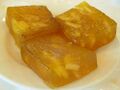 Water Chestnut Cake


Medical Disclaimer: WikiMD is for informational purposes only and is not a substitute for professional medical advice. Content may be inaccurate or outdated and should not be used for diagnosis or treatment. Always consult your healthcare provider for medical decisions. Verify information with trusted sources such as CDC.gov and NIH.gov. By using this site, you agree that WikiMD is not liable for any outcomes related to its content. See full disclaimer.
Credits:Most images are courtesy of Wikimedia commons, and templates, categories Wikipedia, licensed under CC BY SA or similar.
Translate page: - East Asian
中文,
日本,
한국어,
South Asian
हिन्दी,
தமிழ்,
తెలుగు,
Urdu,
ಕನ್ನಡ,
Southeast Asian
Indonesian,
Vietnamese,
Thai,
မြန်မာဘာသာ,
বাংলা
European
español,
Deutsch,
français,
Greek,
português do Brasil,
polski,
română,
русский,
Nederlands,
norsk,
svenska,
suomi,
Italian
Middle Eastern & African
عربى,
Turkish,
Persian,
Hebrew,
Afrikaans,
isiZulu,
Kiswahili,
Other
Bulgarian,
Hungarian,
Czech,
Swedish,
മലയാളം,
मराठी,
ਪੰਜਾਬੀ,
ગુજરાતી,
Portuguese,
Ukrainian


