Cervical effacement
Cervical Effacement refers to the process by which the cervix prepares for childbirth. It is a significant part of the labor process and is often used as an indicator of labor progression.
Overview[edit]
During pregnancy, the cervix is typically 2 to 3 cm long. As labor approaches, the cervix begins to shorten or "efface". This is the process of cervical effacement. It is measured in percentages, from 0% (no effacement) to 100% (fully effaced).
Process[edit]
Cervical effacement is facilitated by the hormone prostaglandin. This hormone helps to soften the cervix, allowing it to thin out and stretch in preparation for childbirth. The process of effacement is usually gradual and can take days or weeks. However, in some cases, it can occur rapidly over a few hours.
Measurement[edit]
Cervical effacement is measured during a pelvic examination. The healthcare provider will assess the thickness of the cervix and express it as a percentage. A cervix that is 50% effaced is half as thick as it was before effacement began. When the cervix is 100% effaced, it is completely thinned out and ready for dilation.
Relation to Dilation[edit]
Cervical effacement and dilation often occur simultaneously, but this is not always the case. Some women may become fully effaced before their cervix begins to dilate, while others may begin to dilate without significant effacement. Both processes are necessary for a vaginal birth.
Importance[edit]
Understanding cervical effacement is important for healthcare providers as it helps them to assess the progression of labor and make appropriate decisions regarding the management of labor and delivery. It is also useful for expectant mothers to understand the process, as it can help them to better understand what is happening in their bodies during labor.
See Also[edit]
This obstetrics related article is a stub.
-
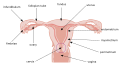 Diagram of the cervix
 -
Microscopic view of cervical cells
-
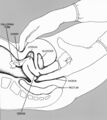 Pelvic examination


Medical Disclaimer: WikiMD is for informational purposes only and is not a substitute for professional medical advice. Content may be inaccurate or outdated and should not be used for diagnosis or treatment. Always consult your healthcare provider for medical decisions. Verify information with trusted sources such as CDC.gov and NIH.gov. By using this site, you agree that WikiMD is not liable for any outcomes related to its content. See full disclaimer.
Credits:Most images are courtesy of Wikimedia commons, and templates, categories Wikipedia, licensed under CC BY SA or similar.
Translate page: - East Asian
中文,
日本,
한국어,
South Asian
हिन्दी,
தமிழ்,
తెలుగు,
Urdu,
ಕನ್ನಡ,
Southeast Asian
Indonesian,
Vietnamese,
Thai,
မြန်မာဘာသာ,
বাংলা
European
español,
Deutsch,
français,
Greek,
português do Brasil,
polski,
română,
русский,
Nederlands,
norsk,
svenska,
suomi,
Italian
Middle Eastern & African
عربى,
Turkish,
Persian,
Hebrew,
Afrikaans,
isiZulu,
Kiswahili,
Other
Bulgarian,
Hungarian,
Czech,
Swedish,
മലയാളം,
मराठी,
ਪੰਜਾਬੀ,
ગુજરાતી,
Portuguese,
Ukrainian


