Active transport
-
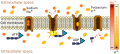 Sodium-potassium pump diagram
 -
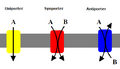 Porters image


Active_transport[edit]
Active Transport[edit]
Active transport is a fundamental biological process that involves the movement of molecules across a cell membrane from a region of lower concentration to a region of higher concentration. This process is essential for maintaining the necessary concentrations of ions and other substances within cells, which is crucial for various cellular functions.
Mechanism[edit]
Active transport requires energy, typically in the form of adenosine triphosphate (ATP), to move substances against their concentration gradient. This is in contrast to passive transport, which does not require energy and occurs along the concentration gradient.
There are two main types of active transport:
Primary Active Transport[edit]
Primary active transport directly uses energy to transport molecules. The most well-known example is the sodium-potassium pump (Na_/K_ pump), which maintains the electrochemical gradient across the plasma membrane by pumping sodium ions out of the cell and potassium ions into the cell.
Secondary Active Transport[edit]
Secondary active transport, also known as cotransport, does not directly use ATP. Instead, it relies on the electrochemical gradient established by primary active transport. There are two types of secondary active transport:
- Symport: Both molecules move in the same direction across the membrane. An example is the sodium-glucose transport protein, which transports glucose into the cell along with sodium ions.
- Antiport: The molecules move in opposite directions. An example is the sodium-calcium exchanger, which moves sodium ions into the cell while transporting calcium ions out.
Importance in Physiology[edit]
Active transport is crucial for various physiological processes, including:
- Maintaining the resting membrane potential in neurons and muscle cells.
- Absorption of nutrients in the intestine.
- Reabsorption of ions and water in the kidneys.
- Regulation of cell volume.
Related Pages[edit]
 | This cell biology article is a stub. You can help WikiMD by expanding the page. |
Advertise on WikiMD — 81,000+ full articles, ~900,000 total pages, ~250 million page views. Global reach, limited time promotional rates from $1/page/day. Learn more · View stats


Translate page: - East Asian
中文,
日本,
한국어,
South Asian
हिन्दी,
தமிழ்,
తెలుగు,
Urdu,
ಕನ್ನಡ,
Southeast Asian
Indonesian,
Vietnamese,
Thai,
မြန်မာဘာသာ,
বাংলা
European
español,
Deutsch,
français,
Greek,
português do Brasil,
polski,
română,
русский,
Nederlands,
norsk,
svenska,
suomi,
Italian
Middle Eastern & African
عربى,
Turkish,
Persian,
Hebrew,
Afrikaans,
isiZulu,
Kiswahili,
Other
Bulgarian,
Hungarian,
Czech,
Swedish,
മലയാളം,
मराठी,
ਪੰਜਾਬੀ,
ગુજરાતી,
Portuguese,
Ukrainian
About WikiMD • Contact • Disclaimer • Privacy • Copyright • Site statistics
Some content and images may originate from Wikimedia Commons or Wikipedia and remain subject to their stated licenses. Unless otherwise noted, eligible WikiMD content is available under CC BY-SA 4.0.
WikiMD Wellnesspedia — Free health & wellness information for patients, students, and health professionals.

