Cardiolipin
Cardiolipin (CL) is a type of lipid that is found in the mitochondria of cells. It is an important component of the inner mitochondrial membrane, where it constitutes about 20% of the total lipid composition. Cardiolipin is crucial for the optimal function of numerous enzymes that are involved in mitochondrial energy metabolism.
Structure[edit]
Cardiolipin is a diphosphatidylglycerol lipid. In other words, it consists of a glycerol backbone, but instead of being linked to one phosphatidic acid molecule, it is linked to two. This gives cardiolipin its unique structure, which is critical for its function in the inner mitochondrial membrane.
Function[edit]
Cardiolipin plays a key role in several important biological processes. These include:
- Apoptosis: Cardiolipin can move from the inner to the outer mitochondrial membrane, where it acts as a signal for the initiation of apoptosis, or programmed cell death.
- Mitochondrial metabolism: Cardiolipin is essential for the optimal function of several enzymes involved in mitochondrial energy metabolism.
- Mitochondrial membrane potential: Cardiolipin contributes to the maintenance of the mitochondrial membrane potential, which is crucial for the production of ATP.
Clinical significance[edit]
Alterations in cardiolipin metabolism have been linked to a variety of diseases, including Barth syndrome, heart failure, diabetes, and neurodegenerative diseases.
- Barth syndrome: This is a rare genetic disorder characterized by cardiomyopathy, skeletal muscle weakness, and neutropenia. It is caused by mutations in the gene that encodes tafazzin, an enzyme involved in the remodeling of cardiolipin.
- Heart failure: Changes in cardiolipin content or composition can impair mitochondrial function, leading to decreased ATP production and heart failure.
- Diabetes: Altered cardiolipin metabolism can lead to insulin resistance and type 2 diabetes.
- Neurodegenerative diseases: Changes in cardiolipin can affect mitochondrial function and lead to neurodegenerative diseases such as Parkinson's disease and Alzheimer's disease.
See also[edit]

This WikiMD article can only be edited by registered and verified editors. You can log in or register.
-
 Structure of Cardiolipin
 -
 Cardiolipin Table
 -
 Bicyclic Structure of Cardiolipin
 -
 Nonyl Acridine Orange
 -
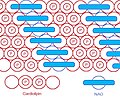 NAO and Cardiolipin
 -
 Eukaryotic Pathway
 -
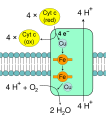 Complex IV
 -
 Apoptosis
 -
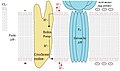 Proton Trap


Medical Disclaimer: WikiMD is for informational purposes only and is not a substitute for professional medical advice. Content may be inaccurate or outdated and should not be used for diagnosis or treatment. Always consult your healthcare provider for medical decisions. Verify information with trusted sources such as CDC.gov and NIH.gov. By using this site, you agree that WikiMD is not liable for any outcomes related to its content. See full disclaimer.
Credits:Most images are courtesy of Wikimedia commons, and templates, categories Wikipedia, licensed under CC BY SA or similar.
Translate page: - East Asian
中文,
日本,
한국어,
South Asian
हिन्दी,
தமிழ்,
తెలుగు,
Urdu,
ಕನ್ನಡ,
Southeast Asian
Indonesian,
Vietnamese,
Thai,
မြန်မာဘာသာ,
বাংলা
European
español,
Deutsch,
français,
Greek,
português do Brasil,
polski,
română,
русский,
Nederlands,
norsk,
svenska,
suomi,
Italian
Middle Eastern & African
عربى,
Turkish,
Persian,
Hebrew,
Afrikaans,
isiZulu,
Kiswahili,
Other
Bulgarian,
Hungarian,
Czech,
Swedish,
മലയാളം,
मराठी,
ਪੰਜਾਬੀ,
ગુજરાતી,
Portuguese,
Ukrainian

