Canoe and kayak diving
Canoe and kayak diving is a type of recreational diving where the divers paddle to a diving site in a canoe or kayak before immersing. This method is a convenient and cost-effective way to reach more distant and less frequently dived sites. Canoe and kayak diving allows divers to explore areas that cannot be easily accessed from shore.
History[edit]
The history of canoe and kayak diving can be traced back to the early days of recreational diving. Divers would often use canoes and kayaks to reach offshore reefs or wrecks that were too far to swim but not worth the expense of chartering a boat. Over time, this practice evolved into a distinct sub-discipline of recreational diving.
Equipment[edit]
The equipment used in canoe and kayak diving typically includes standard scuba diving gear, along with a canoe or kayak and paddling equipment. The canoe or kayak must be large enough to carry the diver and their gear, and stable enough to allow for safe entry and exit from the water. Some divers may also use a dive flag to signal their presence to other water users.
Techniques[edit]
The techniques used in canoe and kayak diving are a combination of those used in scuba diving and paddling. Divers must be able to control their canoe or kayak, navigate to the dive site, and safely enter and exit the water. They must also be able to manage their diving equipment in a confined space, and deal with the potential for adverse weather and sea conditions.
Safety[edit]
Safety is a major concern in canoe and kayak diving. Divers must be aware of the risks associated with both diving and paddling, and take appropriate precautions. This may include carrying safety equipment such as a dive computer, dive knife, and surface marker buoy, and maintaining a high level of fitness and skill.
See also[edit]
References[edit]
-
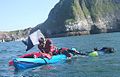 Kayak diving in action
 -
 Canoe diving technique
 -
 Canoe and kayak diving


Medical Disclaimer: WikiMD is for informational purposes only and is not a substitute for professional medical advice. Content may be inaccurate or outdated and should not be used for diagnosis or treatment. Always consult your healthcare provider for medical decisions. Verify information with trusted sources such as CDC.gov and NIH.gov. By using this site, you agree that WikiMD is not liable for any outcomes related to its content. See full disclaimer.
Credits:Most images are courtesy of Wikimedia commons, and templates, categories Wikipedia, licensed under CC BY SA or similar.
Translate page: - East Asian
中文,
日本,
한국어,
South Asian
हिन्दी,
தமிழ்,
తెలుగు,
Urdu,
ಕನ್ನಡ,
Southeast Asian
Indonesian,
Vietnamese,
Thai,
မြန်မာဘာသာ,
বাংলা
European
español,
Deutsch,
français,
Greek,
português do Brasil,
polski,
română,
русский,
Nederlands,
norsk,
svenska,
suomi,
Italian
Middle Eastern & African
عربى,
Turkish,
Persian,
Hebrew,
Afrikaans,
isiZulu,
Kiswahili,
Other
Bulgarian,
Hungarian,
Czech,
Swedish,
മലയാളം,
मराठी,
ਪੰਜਾਬੀ,
ગુજરાતી,
Portuguese,
Ukrainian

