Cancer irroratus

Cancer irroratus, commonly known as the Atlantic rock crab, is a species of crab found in the northwestern Atlantic Ocean. It is a member of the family Cancridae, which includes other species of crabs such as the Dungeness crab and the red rock crab.
Description[edit]
The carapace of Cancer irroratus is typically reddish-brown with a distinctive pattern of lighter spots, which gives the species its name "irroratus," meaning "spotted." The carapace is broad and oval-shaped, with a smooth texture. Adult crabs can reach a carapace width of up to 13 cm (5 inches).
Habitat[edit]
Cancer irroratus is commonly found along the eastern coast of North America, from Nova Scotia to Florida. It inhabits rocky substrates and is often found in intertidal zones and shallow waters, although it can also be found at depths of up to 750 meters (2,460 feet).
Diet[edit]
The Atlantic rock crab is an opportunistic feeder, preying on a variety of organisms. Its diet includes mollusks, small fish, and algae. It uses its strong claws to crush the shells of its prey.
Reproduction[edit]
Reproduction in Cancer irroratus involves a complex mating ritual. Males and females engage in a courtship dance before mating. Females carry fertilized eggs on their abdomen until they hatch into larvae. The larvae undergo several molts before reaching adulthood.
Economic Importance[edit]
Cancer irroratus is of commercial importance in some regions, where it is harvested for its meat. The crab is caught using traps and is considered a delicacy in many coastal communities.
Conservation[edit]
While not currently considered endangered, the populations of Cancer irroratus are monitored to ensure sustainable harvesting practices. Overfishing and habitat destruction are potential threats to its populations.
Related pages[edit]
| Crustaceans | ||||||||||
|---|---|---|---|---|---|---|---|---|---|---|
This crustacean-related article is a stub. You can help WikiMD by expanding it.
|
-
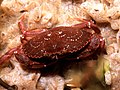 Rock crab on tunicate colony


Medical Disclaimer: WikiMD is for informational purposes only and is not a substitute for professional medical advice. Content may be inaccurate or outdated and should not be used for diagnosis or treatment. Always consult your healthcare provider for medical decisions. Verify information with trusted sources such as CDC.gov and NIH.gov. By using this site, you agree that WikiMD is not liable for any outcomes related to its content. See full disclaimer.
Credits:Most images are courtesy of Wikimedia commons, and templates, categories Wikipedia, licensed under CC BY SA or similar.
Translate page: - East Asian
中文,
日本,
한국어,
South Asian
हिन्दी,
தமிழ்,
తెలుగు,
Urdu,
ಕನ್ನಡ,
Southeast Asian
Indonesian,
Vietnamese,
Thai,
မြန်မာဘာသာ,
বাংলা
European
español,
Deutsch,
français,
Greek,
português do Brasil,
polski,
română,
русский,
Nederlands,
norsk,
svenska,
suomi,
Italian
Middle Eastern & African
عربى,
Turkish,
Persian,
Hebrew,
Afrikaans,
isiZulu,
Kiswahili,
Other
Bulgarian,
Hungarian,
Czech,
Swedish,
മലയാളം,
मराठी,
ਪੰਜਾਬੀ,
ગુજરાતી,
Portuguese,
Ukrainian

