Butyltolylquinuclidine
Butyltolylquinuclidine is a chemical compound with a complex structure. It is a member of the quinuclidine family, which is a class of organic compounds that are part of the larger group of alkaloids. Alkaloids are naturally occurring chemical compounds that contain mostly basic nitrogen atoms.
Chemical Structure[edit]
The chemical structure of Butyltolylquinuclidine is characterized by a quinuclidine core, which is a nitrogen-containing seven-membered ring. This core is substituted with a butyl group and a tolyl group. The butyl group is a four-carbon alkyl group, while the tolyl group is a phenyl group with a methyl substituent.
Synthesis[edit]
The synthesis of Butyltolylquinuclidine involves several steps, starting with the formation of the quinuclidine ring. This is typically achieved through a Mannich reaction, which is a three-component reaction involving an amine, a carbonyl compound, and a formaldehyde. The resulting intermediate is then alkylated with a butyl group and a tolyl group to yield the final product.
Applications[edit]
While the specific applications of Butyltolylquinuclidine are not well-documented, quinuclidine derivatives in general have been found to have a wide range of uses. They are used in the synthesis of pharmaceuticals, agrochemicals, and materials science. For example, some quinuclidine derivatives are used as chiral catalysts in asymmetric synthesis, while others have been found to have antiviral, antibacterial, and antifungal properties.
Safety and Toxicity[edit]
As with any chemical compound, the safety and toxicity of Butyltolylquinuclidine depend on various factors such as the dose, the route of exposure, and the individual's health status. It is always important to handle chemical compounds with care and to follow appropriate safety protocols.

-
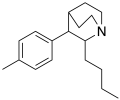 Chemical structure of Butyltolylquinuclidine
 -
 Ball-and-stick model of Butyltolylquinuclidine


Medical Disclaimer: WikiMD is for informational purposes only and is not a substitute for professional medical advice. Content may be inaccurate or outdated and should not be used for diagnosis or treatment. Always consult your healthcare provider for medical decisions. Verify information with trusted sources such as CDC.gov and NIH.gov. By using this site, you agree that WikiMD is not liable for any outcomes related to its content. See full disclaimer.
Credits:Most images are courtesy of Wikimedia commons, and templates, categories Wikipedia, licensed under CC BY SA or similar.
Translate page: - East Asian
中文,
日本,
한국어,
South Asian
हिन्दी,
தமிழ்,
తెలుగు,
Urdu,
ಕನ್ನಡ,
Southeast Asian
Indonesian,
Vietnamese,
Thai,
မြန်မာဘာသာ,
বাংলা
European
español,
Deutsch,
français,
Greek,
português do Brasil,
polski,
română,
русский,
Nederlands,
norsk,
svenska,
suomi,
Italian
Middle Eastern & African
عربى,
Turkish,
Persian,
Hebrew,
Afrikaans,
isiZulu,
Kiswahili,
Other
Bulgarian,
Hungarian,
Czech,
Swedish,
മലയാളം,
मराठी,
ਪੰਜਾਬੀ,
ગુજરાતી,
Portuguese,
Ukrainian

