Butter churn
Butter Churn is a device used to convert cream into butter, a process involving agitation to separate the butterfat from the buttermilk. This method has been in use since ancient times, with evidence of butter churning dating back as far as 2000 BC.
History[edit]
The earliest butter churns were simple wooden devices, but over time, they evolved into more complex machines. The first butter churns were likely made from animal skins or hollowed-out logs. By the Middle Ages, butter churns were commonly made of wood and shaped like barrels. In the 19th century, the invention of the mechanical butter churn revolutionized the dairy industry.
Types of Butter Churns[edit]
There are several types of butter churns, including the plunge churn, the paddle churn, and the barrel churn. The plunge churn, also known as the dash churn, is a tall, narrow cylinder with a lid on top and a long handle attached to a cross piece, or dasher, inside. The paddle churn is a box with a crank on the outside that turns paddles on the inside. The barrel churn is a large barrel that is rotated to churn the butter.
Process[edit]
The process of churning butter involves agitating cream until the fat globules stick together to form butter. This is usually done by adding cream to the churn and then agitating it, either by plunging a dasher up and down or by turning a crank. The agitation causes the fat globules in the cream to clump together, forming butter. The remaining liquid is the buttermilk.
Modern Churning[edit]
Today, most commercial butter is made using industrial churns that can process large volumes of cream. However, many people still churn butter at home using small, hand-cranked churns or even just a jar with a tight-fitting lid. Homemade butter is often considered to have a superior taste and texture to commercially produced butter.
See Also[edit]

 | This agriculture article is a stub. You can help WikiMD by expanding the page. |
-
 Leeds butter churn
 -
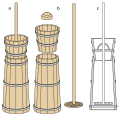 Maśniczka
 -
 Masielnica in Grotniki
 -
 Metal churns at Cork Butter Museum
 -
 Big Chalcolithic churn
 -
 Խնոցի
Խնոցի -
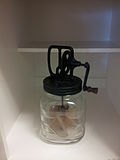 Paddle type hand-cranked butter churn
 -
 Churn for butter with vertical rotation


Medical Disclaimer: WikiMD is for informational purposes only and is not a substitute for professional medical advice. Content may be inaccurate or outdated and should not be used for diagnosis or treatment. Always consult your healthcare provider for medical decisions. Verify information with trusted sources such as CDC.gov and NIH.gov. By using this site, you agree that WikiMD is not liable for any outcomes related to its content. See full disclaimer.
Credits:Most images are courtesy of Wikimedia commons, and templates, categories Wikipedia, licensed under CC BY SA or similar.
Translate this page: - East Asian
中文,
日本,
한국어,
South Asian
हिन्दी,
தமிழ்,
తెలుగు,
Urdu,
ಕನ್ನಡ,
Southeast Asian
Indonesian,
Vietnamese,
Thai,
မြန်မာဘာသာ,
বাংলা
European
español,
Deutsch,
français,
Greek,
português do Brasil,
polski,
română,
русский,
Nederlands,
norsk,
svenska,
suomi,
Italian
Middle Eastern & African
عربى,
Turkish,
Persian,
Hebrew,
Afrikaans,
isiZulu,
Kiswahili,
Other
Bulgarian,
Hungarian,
Czech,
Swedish,
മലയാളം,
मराठी,
ਪੰਜਾਬੀ,
ગુજરાતી,
Portuguese,
Ukrainian
