Butea monosperma
Species of flowering plant
Butea monosperma, commonly known as the Flame of the Forest, Bastard Teak, or Palash, is a species of flowering plant in the Fabaceae family. It is native to tropical and subtropical parts of the Indian subcontinent and Southeast Asia.
Description[edit]

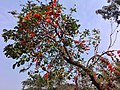
Butea monosperma is a medium-sized deciduous tree that can grow up to 15 meters in height. The tree is known for its striking orange-red flowers, which appear in dense clusters and cover the entire tree, giving it the appearance of being on fire. The leaves are compound, with three leaflets, and are shed before the flowering season.
Distribution and Habitat[edit]
Butea monosperma is found in a variety of habitats, including dry forests, grasslands, and along riverbanks. It is widely distributed across India, Bangladesh, Nepal, Sri Lanka, and parts of Myanmar and Thailand. The tree is well adapted to arid conditions and can thrive in poor soil.
Cultural Significance[edit]
_flowers_in_Kolkata_I_IMG_4225.jpg)
In India, Butea monosperma holds significant cultural and religious importance. It is associated with the festival of Holi, where the flowers are used to make natural dyes. The tree is also considered sacred in some regions and is often planted near temples.
Uses[edit]
The tree has various uses in traditional medicine and industry. The flowers are used to produce a natural dye, while the leaves are used as fodder for livestock. The gum, known as "Butea gum" or "Bengal kino," is used in traditional medicine for its astringent properties.
Ecological Role[edit]
Butea monosperma plays an important role in its ecosystem. The flowers attract a variety of pollinators, including bees and birds, which help in the pollination of the tree. The tree also provides habitat and food for various species of wildlife.
Gallery[edit]
-
 Butea monosperma in Bagh-e-Jinnah
 -
 Bankh prepared from Butea roots
 -
 Palash tree in full bloom
 -
 Close-up of Polash flower
 -
 Butea monosperma plant in Yavatmal, Maharashtra


Related Pages[edit]

Medical Disclaimer: WikiMD is for informational purposes only and is not a substitute for professional medical advice. Content may be inaccurate or outdated and should not be used for diagnosis or treatment. Always consult your healthcare provider for medical decisions. Verify information with trusted sources such as CDC.gov and NIH.gov. By using this site, you agree that WikiMD is not liable for any outcomes related to its content. See full disclaimer.
Credits:Most images are courtesy of Wikimedia commons, and templates, categories Wikipedia, licensed under CC BY SA or similar.
Translate page: - East Asian
中文,
日本,
한국어,
South Asian
हिन्दी,
தமிழ்,
తెలుగు,
Urdu,
ಕನ್ನಡ,
Southeast Asian
Indonesian,
Vietnamese,
Thai,
မြန်မာဘာသာ,
বাংলা
European
español,
Deutsch,
français,
Greek,
português do Brasil,
polski,
română,
русский,
Nederlands,
norsk,
svenska,
suomi,
Italian
Middle Eastern & African
عربى,
Turkish,
Persian,
Hebrew,
Afrikaans,
isiZulu,
Kiswahili,
Other
Bulgarian,
Hungarian,
Czech,
Swedish,
മലയാളം,
मराठी,
ਪੰਜਾਬੀ,
ગુજરાતી,
Portuguese,
Ukrainian

