Brassinosteroid
Brassinosteroid is a class of polyhydroxysteroids that have been recognized as a sixth class of plant hormones. These steroids are essential for plant growth and development, including cell division, cell elongation, differentiation, and apoptosis. They also play a crucial role in plant responses to various abiotic stresses and pathogen attacks.
History[edit]
The first brassinosteroid, brassinolide, was isolated in 1970 from the pollen of Brassica napus, a type of rapeseed. Since then, over 70 brassinosteroids have been isolated from various plant species.
Biosynthesis and Metabolism[edit]
Brassinosteroids are synthesized from campesterol, a common sterol in plants. The biosynthesis process involves several steps, including hydroxylation, oxidation, and reduction. The metabolism of brassinosteroids is still not fully understood, but it is known that they are inactivated by glucosylation.
Function[edit]
Brassinosteroids regulate a wide range of physiological processes in plants. They promote cell elongation and division, enhance photosynthesis, and help plants resist various stresses. They also interact with other plant hormones, such as auxin, gibberellin, and abscisic acid, to regulate plant growth and development.
Significance in Agriculture[edit]
Due to their growth-promoting properties, brassinosteroids have potential applications in agriculture. They can be used to enhance crop yield, improve plant resistance to stresses, and reduce the use of harmful chemical pesticides.
Research[edit]
Research on brassinosteroids is a rapidly growing field. Scientists are studying their biosynthesis, metabolism, and function in plants, as well as their potential applications in agriculture and horticulture.
This plant hormone related article is a stub. You can help WikiMD by expanding it.
 | This article about a steroid is a stub. You can help WikiMD by expanding the page. |
 | This agriculture article is a stub. You can help WikiMD by expanding the page. |
 | This medical article is a stub. You can help WikiMD by expanding the page. |
Brassinosteroid[edit]
-
 Brassinolide structure
 -
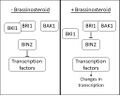 Brassinosteroid signal cascade


Medical Disclaimer: WikiMD is for informational purposes only and is not a substitute for professional medical advice. Content may be inaccurate or outdated and should not be used for diagnosis or treatment. Always consult your healthcare provider for medical decisions. Verify information with trusted sources such as CDC.gov and NIH.gov. By using this site, you agree that WikiMD is not liable for any outcomes related to its content. See full disclaimer.
Credits:Most images are courtesy of Wikimedia commons, and templates, categories Wikipedia, licensed under CC BY SA or similar.
Translate page: - East Asian
中文,
日本,
한국어,
South Asian
हिन्दी,
தமிழ்,
తెలుగు,
Urdu,
ಕನ್ನಡ,
Southeast Asian
Indonesian,
Vietnamese,
Thai,
မြန်မာဘာသာ,
বাংলা
European
español,
Deutsch,
français,
Greek,
português do Brasil,
polski,
română,
русский,
Nederlands,
norsk,
svenska,
suomi,
Italian
Middle Eastern & African
عربى,
Turkish,
Persian,
Hebrew,
Afrikaans,
isiZulu,
Kiswahili,
Other
Bulgarian,
Hungarian,
Czech,
Swedish,
മലയാളം,
मराठी,
ਪੰਜਾਬੀ,
ગુજરાતી,
Portuguese,
Ukrainian

