Bi-specific T-cell engager
Bi-specific T-cell engager (also known as BiTE) is a type of biological therapy used in the treatment of cancer. BiTEs are a class of artificial bispecific monoclonal antibody that can simultaneously bind to two different types of protein on the surface of cells.
Mechanism of Action[edit]
Bi-specific T-cell engagers work by binding to both T cells and cancer cells simultaneously. One arm of the BiTE binds to the CD3 protein on the T cell, while the other arm binds to a specific protein on the cancer cell. This dual binding action brings the T cell into close proximity with the cancer cell, which allows the T cell to destroy the cancer cell.
Clinical Use[edit]
Bi-specific T-cell engagers have been used in the treatment of various types of cancer, including leukemia, lymphoma, and solid tumors. The first BiTE, blinatumomab, was approved by the FDA in 2014 for the treatment of acute lymphoblastic leukemia.
Advantages and Disadvantages[edit]
The main advantage of BiTE therapy is its ability to harness the body's own immune system to fight cancer. However, this therapy can also cause severe side effects, including cytokine release syndrome, which is a systemic inflammatory response caused by the rapid release of cytokines from activated T cells.
Future Directions[edit]
Research is ongoing to develop new BiTEs for the treatment of other types of cancer. In addition, scientists are studying ways to reduce the side effects of BiTE therapy and to combine it with other types of cancer treatment for a more effective response.
 | This medical article is a stub. You can help WikiMD by expanding the page. |
-
Bi-specific T-cell engager
-
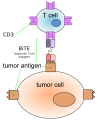 BiTE antibody


Medical Disclaimer: WikiMD is for informational purposes only and is not a substitute for professional medical advice. Content may be inaccurate or outdated and should not be used for diagnosis or treatment. Always consult your healthcare provider for medical decisions. Verify information with trusted sources such as CDC.gov and NIH.gov. By using this site, you agree that WikiMD is not liable for any outcomes related to its content. See full disclaimer.
Credits:Most images are courtesy of Wikimedia commons, and templates, categories Wikipedia, licensed under CC BY SA or similar.
Translate page: - East Asian
中文,
日本,
한국어,
South Asian
हिन्दी,
தமிழ்,
తెలుగు,
Urdu,
ಕನ್ನಡ,
Southeast Asian
Indonesian,
Vietnamese,
Thai,
မြန်မာဘာသာ,
বাংলা
European
español,
Deutsch,
français,
Greek,
português do Brasil,
polski,
română,
русский,
Nederlands,
norsk,
svenska,
suomi,
Italian
Middle Eastern & African
عربى,
Turkish,
Persian,
Hebrew,
Afrikaans,
isiZulu,
Kiswahili,
Other
Bulgarian,
Hungarian,
Czech,
Swedish,
മലയാളം,
मराठी,
ਪੰਜਾਬੀ,
ગુજરાતી,
Portuguese,
Ukrainian


