Baby corn
Baby corn is a cereal grain taken from corn (maize) harvested early while the stalks are still small and immature. It typically is eaten whole – cob included – in contrast to mature corn, whose cob is too tough for human consumption. Baby corn is commonly used in Asian cuisine.
Cultivation[edit]
Baby corn is harvested early, when it is very young, usually within two to three days after the silks have emerged and before pollination occurs. The cobs are hand-picked as soon as the silks emerge from the ear tips, or a few days after. Corn generally matures very quickly, so the harvest period is often only one to two days. The immature ears are hand-picked and immediately put into cold storage to prevent the kernels from further maturing.
Nutritional Value[edit]
Baby corn is low in fat and high in potassium and fiber. It is also a decent source of vitamin B, folic acid, and protein. Baby corn also contains essential nutrients including vitamin C, vitamin A, and iron.
Culinary Uses[edit]
Baby corn is used in many dishes due to its sweet taste and crunchy texture. It is often added to stir fry dishes, salads, and soups. It can also be eaten raw or pickled. In Asian cuisine, it is often used in dishes like pad thai and chop suey.
See Also[edit]

-
 Baby corn
 -
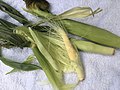 Baby corn still in husks
 -
 Stir fry showcasing baby corn


.jpg)

Medical Disclaimer: WikiMD is for informational purposes only and is not a substitute for professional medical advice. Content may be inaccurate or outdated and should not be used for diagnosis or treatment. Always consult your healthcare provider for medical decisions. Verify information with trusted sources such as CDC.gov and NIH.gov. By using this site, you agree that WikiMD is not liable for any outcomes related to its content. See full disclaimer.
Credits:Most images are courtesy of Wikimedia commons, and templates, categories Wikipedia, licensed under CC BY SA or similar.
Translate page: - East Asian
中文,
日本,
한국어,
South Asian
हिन्दी,
தமிழ்,
తెలుగు,
Urdu,
ಕನ್ನಡ,
Southeast Asian
Indonesian,
Vietnamese,
Thai,
မြန်မာဘာသာ,
বাংলা
European
español,
Deutsch,
français,
Greek,
português do Brasil,
polski,
română,
русский,
Nederlands,
norsk,
svenska,
suomi,
Italian
Middle Eastern & African
عربى,
Turkish,
Persian,
Hebrew,
Afrikaans,
isiZulu,
Kiswahili,
Other
Bulgarian,
Hungarian,
Czech,
Swedish,
മലയാളം,
मराठी,
ਪੰਜਾਬੀ,
ગુજરાતી,
Portuguese,
Ukrainian

