Cerebral aqueduct
Cerebral Aqueduct
The cerebral aqueduct, also known as the aqueduct of Sylvius, is a narrow channel located within the brain that connects the third and fourth ventricles. It is a part of the ventricular system and plays a crucial role in the circulation of cerebrospinal fluid (CSF).
Anatomy[edit]
The cerebral aqueduct is a small, cylindrical, and narrow canal approximately 15 to 20 millimeters in length and 2 millimeters in diameter. It is located in the midbrain, specifically in the tegmentum, and runs from the posterior end of the third ventricle to the anterior end of the fourth ventricle.
Function[edit]
The primary function of the cerebral aqueduct is to allow the passage of CSF from the third ventricle, located in the midbrain, to the fourth ventricle, located between the pons and cerebellum. This ensures the continuous circulation of CSF throughout the brain, which is essential for the protection and nourishment of the brain.
Clinical Significance[edit]
Blockage or narrowing of the cerebral aqueduct can lead to a condition known as hydrocephalus, which is characterized by an excessive accumulation of CSF in the brain. This can cause increased intracranial pressure, leading to symptoms such as headaches, nausea, vomiting, and in severe cases, cognitive impairment and physical disability. Treatment typically involves the surgical insertion of a shunt to drain the excess fluid.
See Also[edit]

This article is a neuroanatomy stub. You can help WikiMD by expanding it!
-
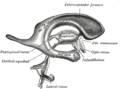
 Diagram of the oculomotor nerve nucleus
 -
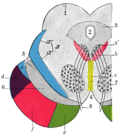
 Transverse section of mid-brain at level of inferior colliculi
 -
 Section of the mid-brain at the level of the superior colliculi
 -
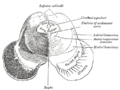 Section of the mid-brain at the level of the inferior colliculi
 -
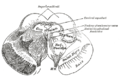 Section of the mid-brain at the level of the superior colliculi
 -
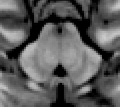 MRI showing the periaqueductal gray
 -
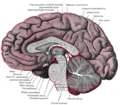 Transverse section of mid-brain at level of superior colliculi
 -
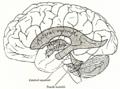 Transverse section of mid-brain at level of inferior colliculi
 -
 Cerebral aqueduct
 -
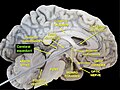 Cerebral aqueduct
 -
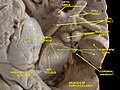 Cerebral aqueduct
 -
 Cerebral aqueduct


Ad. Transform your life with W8MD's
GLP-1 weight loss injections special from $29.99 with insurance
|
WikiMD Medical Encyclopedia |
Medical Disclaimer: WikiMD is for informational purposes only and is not a substitute for professional medical advice. Content may be inaccurate or outdated and should not be used for diagnosis or treatment. Always consult your healthcare provider for medical decisions. Verify information with trusted sources such as CDC.gov and NIH.gov. By using this site, you agree that WikiMD is not liable for any outcomes related to its content. See full disclaimer.
Credits:Most images are courtesy of Wikimedia commons, and templates, categories Wikipedia, licensed under CC BY SA or similar.
Translate this page: - East Asian
中文,
日本,
한국어,
South Asian
हिन्दी,
தமிழ்,
తెలుగు,
Urdu,
ಕನ್ನಡ,
Southeast Asian
Indonesian,
Vietnamese,
Thai,
မြန်မာဘာသာ,
বাংলা
European
español,
Deutsch,
français,
Greek,
português do Brasil,
polski,
română,
русский,
Nederlands,
norsk,
svenska,
suomi,
Italian
Middle Eastern & African
عربى,
Turkish,
Persian,
Hebrew,
Afrikaans,
isiZulu,
Kiswahili,
Other
Bulgarian,
Hungarian,
Czech,
Swedish,
മലയാളം,
मराठी,
ਪੰਜਾਬੀ,
ગુજરાતી,
Portuguese,
Ukrainian
