Aquatic feeding mechanisms
-
 Giant Grouper
 -
 Manta alfredi ram feeding
 -
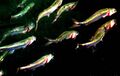 Herring feeding
 -
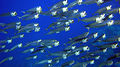 Fish near the beach of Sharm El Naga
 -
 Humpback whale
 -
 Seahorse
 -
 Filter feeding krill


Aquatic Feeding Mechanisms[edit]
Aquatic feeding mechanisms refer to the diverse strategies and anatomical adaptations that aquatic organisms use to capture and consume food in water environments. These mechanisms have evolved to exploit the unique properties of water, such as its density and viscosity, which influence how food particles are captured and ingested.
Filter Feeding[edit]
Filter feeding is a common feeding strategy among aquatic organisms, including many species of fish, whales, and invertebrates. Filter feeders extract small particles, such as plankton, from the water. This is often achieved by passing water through specialized structures that trap food particles. For example, baleen whales use baleen plates to filter krill and small fish from seawater, while bivalves like clams and mussels use gill structures to filter plankton.
Suction Feeding[edit]
Suction feeding is a method used by many fish and some amphibians. It involves rapidly expanding the mouth cavity to create a negative pressure that draws water and prey into the mouth. This technique is highly effective for capturing elusive prey. Fish such as bass and groupers are well-known suction feeders, using their powerful buccal muscles to generate the necessary suction force.
Ram Feeding[edit]
Ram feeding involves an organism moving forward with its mouth open to engulf prey. This method is often used by fast-swimming predators such as sharks and some species of fish. Ram feeders rely on their speed and agility to overtake prey, capturing it directly with their jaws.
Biting and Chewing[edit]
Some aquatic organisms use biting and chewing to capture and process food. This method is common among predatory fish and marine mammals. For example, sharks use their sharp teeth to bite and tear flesh, while sea otters use their teeth to crack open shellfish.
Grazing[edit]
Grazing is a feeding strategy where organisms feed on algae or other plant material growing on surfaces. Many herbivorous fish, such as parrotfish, and invertebrates, like sea urchins, are grazers. They often have specialized mouthparts or teeth adapted to scrape or bite off plant material.
Deposit Feeding[edit]
Deposit feeding involves consuming organic material deposited on or within the substrate. Many benthic organisms, such as certain species of worms and sea cucumbers, are deposit feeders. They ingest sediment and extract nutrients from the organic matter within it.
Related Pages[edit]

Medical Disclaimer: WikiMD is for informational purposes only and is not a substitute for professional medical advice. Content may be inaccurate or outdated and should not be used for diagnosis or treatment. Always consult your healthcare provider for medical decisions. Verify information with trusted sources such as CDC.gov and NIH.gov. By using this site, you agree that WikiMD is not liable for any outcomes related to its content. See full disclaimer.
Credits:Most images are courtesy of Wikimedia commons, and templates, categories Wikipedia, licensed under CC BY SA or similar.
Translate page: - East Asian
中文,
日本,
한국어,
South Asian
हिन्दी,
தமிழ்,
తెలుగు,
Urdu,
ಕನ್ನಡ,
Southeast Asian
Indonesian,
Vietnamese,
Thai,
မြန်မာဘာသာ,
বাংলা
European
español,
Deutsch,
français,
Greek,
português do Brasil,
polski,
română,
русский,
Nederlands,
norsk,
svenska,
suomi,
Italian
Middle Eastern & African
عربى,
Turkish,
Persian,
Hebrew,
Afrikaans,
isiZulu,
Kiswahili,
Other
Bulgarian,
Hungarian,
Czech,
Swedish,
മലയാളം,
मराठी,
ਪੰਜਾਬੀ,
ગુજરાતી,
Portuguese,
Ukrainian

