Aminopropionitrile
Aminopropionitrile (also known as beta-aminopropionitrile or BAPN) is a chemical compound that is used in biochemistry and medicine for its inhibitory effects on the enzyme lysyl oxidase. This enzyme is responsible for the cross-linking of collagen and elastin, which are essential components of the extracellular matrix in animals.
Chemical Structure and Properties[edit]
Aminopropionitrile is a small, organic molecule with the chemical formula C3H6N2. It contains a nitrile group (-CN) and an amino group (-NH2), which are attached to a three-carbon alkane backbone. The molecule is polar due to the presence of these functional groups, and it is soluble in water.
Biological Effects[edit]
In the body, aminopropionitrile acts as a lysyl oxidase inhibitor, preventing the enzyme from catalyzing the formation of cross-links in collagen and elastin. This can lead to a condition known as lathyrism, which is characterized by weakened connective tissues and can cause symptoms such as joint laxity and skin elasticity.
Medical Uses[edit]
Aminopropionitrile has been used in research to study the role of lysyl oxidase in various diseases, including cancer, fibrosis, and cardiovascular disease. It has also been used to induce experimental lathyrism in animals, which can provide insights into the pathology of connective tissue disorders.
Safety and Toxicity[edit]
Exposure to aminopropionitrile can cause irritation to the eyes, skin, and respiratory tract. Ingestion or inhalation of large amounts can lead to symptoms of lathyrism. Therefore, appropriate safety measures should be taken when handling this compound.
See Also[edit]

 | This medical article is a stub. You can help WikiMD by expanding the page. |
-
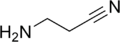 Aminopropionitrile structure
 -
Aminopropionitrile 3D ball model


Medical Disclaimer: WikiMD is for informational purposes only and is not a substitute for professional medical advice. Content may be inaccurate or outdated and should not be used for diagnosis or treatment. Always consult your healthcare provider for medical decisions. Verify information with trusted sources such as CDC.gov and NIH.gov. By using this site, you agree that WikiMD is not liable for any outcomes related to its content. See full disclaimer.
Credits:Most images are courtesy of Wikimedia commons, and templates, categories Wikipedia, licensed under CC BY SA or similar.
Translate page: - East Asian
中文,
日本,
한국어,
South Asian
हिन्दी,
தமிழ்,
తెలుగు,
Urdu,
ಕನ್ನಡ,
Southeast Asian
Indonesian,
Vietnamese,
Thai,
မြန်မာဘာသာ,
বাংলা
European
español,
Deutsch,
français,
Greek,
português do Brasil,
polski,
română,
русский,
Nederlands,
norsk,
svenska,
suomi,
Italian
Middle Eastern & African
عربى,
Turkish,
Persian,
Hebrew,
Afrikaans,
isiZulu,
Kiswahili,
Other
Bulgarian,
Hungarian,
Czech,
Swedish,
മലയാളം,
मराठी,
ਪੰਜਾਬੀ,
ગુજરાતી,
Portuguese,
Ukrainian


