Alveolar gland
-
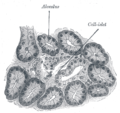 Alveolar gland
 -
 Simple branched acinar gland
 -
 Compound tubulo-acinar gland
 -
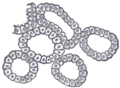 Alveolar gland
 -
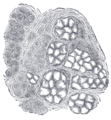 Alveolar gland
 -
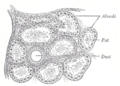 Alveolar gland


Alveolar gland[edit]
An alveolar gland is a type of exocrine gland characterized by its sac-like secretory units. These glands are also known as acinar glands, and they play a crucial role in the secretion of various substances in the body. Alveolar glands can be found in several locations, including the mammary glands, sebaceous glands, and certain salivary glands.
Structure[edit]
Alveolar glands are composed of clusters of secretory cells that form small, rounded sacs called alveoli. These alveoli are connected to a duct system that transports the secreted substances to the surface of the epithelium. The secretory cells in the alveoli are typically arranged in a single layer and are responsible for producing the gland's specific secretion.
The duct system of an alveolar gland can be simple or branched. In simple alveolar glands, each alveolus is connected directly to the main duct. In compound alveolar glands, multiple alveoli are connected to a branched duct system, which eventually leads to a single main duct.
Function[edit]
The primary function of alveolar glands is to produce and secrete substances necessary for various physiological processes. For example, the alveolar glands in the mammary glands produce milk during lactation. Sebaceous glands, which are also alveolar in structure, secrete sebum, an oily substance that helps to lubricate and protect the skin.
Types of Secretion[edit]
Alveolar glands can be classified based on the type of secretion they produce:
- Serous glands: These glands secrete a watery, protein-rich fluid. An example is the parotid gland, a type of salivary gland.
- Mucous glands: These glands secrete a viscous, carbohydrate-rich fluid. The sublingual gland is an example of a mucous gland.
- Mixed glands: These glands produce both serous and mucous secretions. The submandibular gland is an example of a mixed gland.
Related pages[edit]
| Epithelial tissue | ||||||||||||||||||||||||||||||||
|---|---|---|---|---|---|---|---|---|---|---|---|---|---|---|---|---|---|---|---|---|---|---|---|---|---|---|---|---|---|---|---|---|
|

Medical Disclaimer: WikiMD is for informational purposes only and is not a substitute for professional medical advice. Content may be inaccurate or outdated and should not be used for diagnosis or treatment. Always consult your healthcare provider for medical decisions. Verify information with trusted sources such as CDC.gov and NIH.gov. By using this site, you agree that WikiMD is not liable for any outcomes related to its content. See full disclaimer.
Credits:Most images are courtesy of Wikimedia commons, and templates, categories Wikipedia, licensed under CC BY SA or similar.
Translate page: - East Asian
中文,
日本,
한국어,
South Asian
हिन्दी,
தமிழ்,
తెలుగు,
Urdu,
ಕನ್ನಡ,
Southeast Asian
Indonesian,
Vietnamese,
Thai,
မြန်မာဘာသာ,
বাংলা
European
español,
Deutsch,
français,
Greek,
português do Brasil,
polski,
română,
русский,
Nederlands,
norsk,
svenska,
suomi,
Italian
Middle Eastern & African
عربى,
Turkish,
Persian,
Hebrew,
Afrikaans,
isiZulu,
Kiswahili,
Other
Bulgarian,
Hungarian,
Czech,
Swedish,
മലയാളം,
मराठी,
ਪੰਜਾਬੀ,
ગુજરાતી,
Portuguese,
Ukrainian

