Alpha decay
-
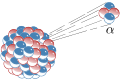 Alpha Decay
 -
 Ndslivechart


Alpha Decay[edit]
Alpha decay is a type of radioactive decay in which an atomic nucleus emits an alpha particle and thereby transforms into a different nucleus with a mass number reduced by four and an atomic number reduced by two. This process is a common mode of decay for heavy nuclei, such as those of uranium, thorium, and radium.
Mechanism[edit]
In alpha decay, the parent nucleus ejects an alpha particle, which consists of two protons and two neutrons, equivalent to a helium-4 nucleus. The emission of the alpha particle results in the formation of a daughter nucleus that is lighter and has a lower atomic number. For example, when uranium-238 undergoes alpha decay, it transforms into thorium-234:
- \( ^{238}_{92}U \rightarrow ^{234}_{90}Th + ^{4}_{2}He \)
The process of alpha decay is governed by the quantum tunneling effect, where the alpha particle overcomes the nuclear potential barrier despite not having enough energy to do so classically.
Energy Release[edit]
The energy released during alpha decay is primarily carried away by the kinetic energy of the alpha particle. This energy is typically in the range of 4 to 9 MeV (million electron volts). The energy release is a result of the difference in binding energy between the parent and daughter nuclei.
Half-Life[edit]
The half-life of a radioactive isotope undergoing alpha decay is the time required for half of the sample to decay. This period can vary widely among different isotopes, from microseconds to billions of years. The half-life is a crucial factor in determining the stability and longevity of a radioactive element.
Applications[edit]
Alpha decay has several practical applications. It is used in smoke detectors, where the alpha particles ionize air molecules, allowing the detection of smoke particles. Alpha-emitting isotopes are also used in radioisotope thermoelectric generators (RTGs) to provide power for spacecraft and remote installations.
Health Effects[edit]
While alpha particles are not highly penetrating and can be stopped by a sheet of paper or the outer layer of human skin, they can cause significant damage if alpha-emitting materials are ingested or inhaled. Inside the body, alpha particles can cause severe damage to living cells and tissues, leading to increased risks of cancer and other health issues.
Related Pages[edit]
| Radioactivity | ||||||||||
|---|---|---|---|---|---|---|---|---|---|---|
This radioactivity-related article is a stub.
|
Sponsored Health Resource

W8MD Weight Loss, Sleep & MedSpa
Looking for physician-supervised weight loss, semaglutide, tirzepatide, or GLP-1 receptor agonist options? W8MD helps eligible patients in New York City, Brooklyn, New Jersey, Connecticut, Pennsylvania, Delaware, and greater Philadelphia with medical weight loss, sleep medicine, and long-term maintenance support.
GLP-1 specials: Affordable GLP-1 injections NYC and Philadelphia starting from $29.99/week and up for semaglutide with insurance accepted for qualifying visits, and $45/week and up for tirzepatide with insurance accepted for qualifying visits. Self-pay options start from $59.99/week and up for semaglutide and $69.99/week and up for tirzepatide.
- Medical weight loss NYC
- Affordable GLP-1 injections NYC
- Budget GLP-1 weight loss shots Philadelphia
- New Jersey medical weight loss
- NYC medical weight loss blog
- Philadelphia weight loss blog
- Sleep medicine and sleep apnea services
- W8MD MedSpa and wellness
Book a W8MD appointment · View GLP-1 specials
Paid promotional message. Eligibility, pricing, insurance coverage, medication availability, and results vary. Medical evaluation required.

Medical Disclaimer: WikiMD is for informational purposes only and is not a substitute for professional medical advice. Content may be inaccurate or outdated and should not be used for diagnosis or treatment. Always consult your healthcare provider for medical decisions. Verify information with trusted sources such as CDC.gov and NIH.gov. By using this site, you agree that WikiMD is not liable for any outcomes related to its content. See full disclaimer.
Credits:Most images are courtesy of Wikimedia commons, and templates, categories Wikipedia, licensed under CC BY SA or similar.
Translate page: - East Asian
中文,
日本,
한국어,
South Asian
हिन्दी,
தமிழ்,
తెలుగు,
Urdu,
ಕನ್ನಡ,
Southeast Asian
Indonesian,
Vietnamese,
Thai,
မြန်မာဘာသာ,
বাংলা
European
español,
Deutsch,
français,
Greek,
português do Brasil,
polski,
română,
русский,
Nederlands,
norsk,
svenska,
suomi,
Italian
Middle Eastern & African
عربى,
Turkish,
Persian,
Hebrew,
Afrikaans,
isiZulu,
Kiswahili,
Other
Bulgarian,
Hungarian,
Czech,
Swedish,
മലയാളം,
मराठी,
ਪੰਜਾਬੀ,
ગુજરાતી,
Portuguese,
Ukrainian

