Cutaneous leishmaniasis

Editor-In-Chief: Prab R Tumpati, MD
Obesity, Sleep & Internal medicine
Founder, WikiMD Wellnesspedia &
W8MD's weight loss doctor NYC
Philadelphia GLP-1 weight loss and GLP-1 clinic NYC
| Cutaneous leishmaniasis | |
|---|---|

| |
| Synonyms | N/A |
| Pronounce | N/A |
| Specialty | N/A |
| Symptoms | Skin ulcer, skin lesion |
| Complications | Secondary infection, scarring |
| Onset | Weeks to months after sandfly bite |
| Duration | Months to years |
| Types | N/A |
| Causes | Leishmania parasite |
| Risks | Sandfly exposure, immunocompromised state |
| Diagnosis | Microscopy, culture, PCR |
| Differential diagnosis | Leprosy, cutaneous tuberculosis, fungal infection |
| Prevention | Insect repellent, protective clothing, bed nets |
| Treatment | Antimonial drugs, amphotericin B, miltefosine |
| Medication | N/A |
| Prognosis | Generally good with treatment |
| Frequency | 0.7 to 1.2 million cases per year worldwide |
| Deaths | N/A |
Cutaneous leishmaniasis is a parasitic disease caused by protozoa of the genus Leishmania. It is transmitted to humans by the bite of infected female sandflies. The disease presents in the skin and can cause a range of clinical symptoms, from ulcers that fully heal to destructive mucosal disease.
Etiology[edit]
Cutaneous leishmaniasis is caused by protozoan parasites from the Leishmania genus. The most common species causing cutaneous leishmaniasis include Leishmania major, Leishmania tropica, and Leishmania aethiopica in the Old World, and Leishmania mexicana, Leishmania amazonensis, and Leishmania braziliensis in the New World.
Transmission[edit]
The disease is transmitted by the bite of female sandflies of the genus Phlebotomus in the Old World and Lutzomyia in the New World. The sandflies are tiny, their bite is often painless, and they are most active in twilight, evening, and night hours.
Clinical Presentation[edit]
The clinical presentation of cutaneous leishmaniasis can vary greatly. The most common form of the disease causes skin ulcers on the exposed parts of the body, such as the face, arms, and legs. There may also be swollen glands near the site of the initial lesion.
Diagnosis[edit]
Diagnosis of cutaneous leishmaniasis is made by identifying the parasite in a smear taken from the ulcer. The parasite can also be grown in culture from the sample. Other diagnostic methods include polymerase chain reaction (PCR) and immunohistochemistry.
Treatment[edit]
Treatment of cutaneous leishmaniasis depends on the species of Leishmania causing the infection and the clinical presentation of the disease. Antimonial drugs, such as sodium stibogluconate and meglumine antimoniate, are the most common treatments. Other treatments include amphotericin B, pentamidine, and miltefosine.
Prevention[edit]
Prevention of cutaneous leishmaniasis includes control of sandflies and personal protection measures such as using insect repellent, wearing protective clothing, and sleeping under a bednet.
Gallery[edit]
-
 Cutaneous leishmaniasis
 -
 Cutaneous leishmaniasis
 -
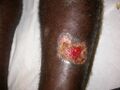 Cutaneous leishmaniasis
 -
 Cutaneous leishmaniasis
 -
 Cutaneous leishmaniasis


See Also[edit]

Sponsored Health Resource

W8MD Weight Loss, Sleep & MedSpa
Looking for physician-supervised weight loss, semaglutide, tirzepatide, or GLP-1 receptor agonist options? W8MD helps eligible patients in New York City, Brooklyn, New Jersey, Connecticut, Pennsylvania, Delaware, and greater Philadelphia with medical weight loss, sleep medicine, and long-term maintenance support.
GLP-1 specials: Affordable GLP-1 injections NYC and Philadelphia starting from $29.99/week and up for semaglutide with insurance accepted for qualifying visits, and $45/week and up for tirzepatide with insurance accepted for qualifying visits. Self-pay options start from $59.99/week and up for semaglutide and $69.99/week and up for tirzepatide.
Medical weight loss NYC | Affordable GLP-1 injections NYC | Budget GLP-1 weight loss shots Philadelphia | New Jersey medical weight loss | NYC medical weight loss | Philadelphia medical weight loss | Sleep clinic NYC | W8MD's Philadelphia GLP-1 doctor | Weight loss prescriptions NYC
Book a W8MD appointment · View GLP-1 specials
Paid promotional message. Eligibility, pricing, insurance coverage, medication availability, and results vary. Medical evaluation required.

Medical Disclaimer: WikiMD is for informational purposes only and is not a substitute for professional medical advice. Content may be inaccurate or outdated and should not be used for diagnosis or treatment. Always consult your healthcare provider for medical decisions. Verify information with trusted sources such as CDC.gov and NIH.gov. By using this site, you agree that WikiMD is not liable for any outcomes related to its content. See full disclaimer.
Credits:Most images are courtesy of Wikimedia commons, and templates, categories Wikipedia, licensed under CC BY SA or similar.
Translate page: - East Asian
中文,
日本,
한국어,
South Asian
हिन्दी,
தமிழ்,
తెలుగు,
Urdu,
ಕನ್ನಡ,
Southeast Asian
Indonesian,
Vietnamese,
Thai,
မြန်မာဘာသာ,
বাংলা
European
español,
Deutsch,
français,
Greek,
português do Brasil,
polski,
română,
русский,
Nederlands,
norsk,
svenska,
suomi,
Italian
Middle Eastern & African
عربى,
Turkish,
Persian,
Hebrew,
Afrikaans,
isiZulu,
Kiswahili,
Other
Bulgarian,
Hungarian,
Czech,
Swedish,
മലയാളം,
मराठी,
ਪੰਜਾਬੀ,
ગુજરાતી,
Portuguese,
Ukrainian

