Adipogenesis
The process of cell differentiation by which preadipocytes become adipocytes
Adipogenesis is the process of cell differentiation by which preadipocytes become adipocytes, or fat cells. This process is crucial for the development of adipose tissue, which plays a significant role in energy storage, insulation, and endocrine functions in the body.
Overview[edit]
Adipogenesis involves a series of complex steps that transform mesenchymal stem cells into mature adipocytes. This process is regulated by a network of transcription factors, signaling pathways, and environmental cues.
Stages of Adipogenesis[edit]
Adipogenesis can be divided into several stages:
Commitment[edit]
The first stage involves the commitment of mesenchymal stem cells to the adipocyte lineage. This is influenced by various factors, including bone morphogenetic proteins (BMPs) and Wnt signaling.
Clonal Expansion[edit]
Once committed, preadipocytes undergo clonal expansion, a phase of rapid cell division. This stage is essential for increasing the number of cells that will eventually differentiate into adipocytes.
Differentiation[edit]
During differentiation, preadipocytes exit the cell cycle and begin to express genes characteristic of mature adipocytes. Key transcription factors involved in this process include PPAR_ (peroxisome proliferator-activated receptor gamma) and C/EBP_ (CCAAT/enhancer-binding protein alpha).
Maturation[edit]
In the final stage, adipocytes mature and accumulate lipid droplets, which are visible under a microscope. Mature adipocytes are capable of storing large amounts of triglycerides and play a role in metabolism and endocrine signaling.
Regulation of Adipogenesis[edit]
Adipogenesis is tightly regulated by a variety of factors:
- Hormonal Regulation: Hormones such as insulin, glucocorticoids, and thyroid hormones influence adipogenesis by modulating the activity of transcription factors and signaling pathways.
- Nutritional Status: Nutrient availability and energy balance affect adipogenesis. For example, high-fat diets can promote the formation of new adipocytes.
- Genetic Factors: Genetic predispositions can influence the efficiency and extent of adipogenesis, impacting body fat distribution and risk of metabolic diseases.
Clinical Significance[edit]
Dysregulation of adipogenesis is associated with various metabolic disorders, including obesity, type 2 diabetes, and lipodystrophy. Understanding the mechanisms of adipogenesis can aid in the development of therapeutic strategies for these conditions.
Related pages[edit]
Gallery[edit]
-
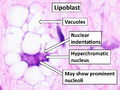 Annotated image of lipoblast features
 -
 Differentiated 3T3-L1 cell line stained with Oil O Red


Advertise on WikiMD — 81,000+ full articles, ~900,000 total pages, ~250 million page views. Global reach, limited time promotional rates from $1/page/day. Learn more · View stats

Translate page: - East Asian
中文,
日本,
한국어,
South Asian
हिन्दी,
தமிழ்,
తెలుగు,
Urdu,
ಕನ್ನಡ,
Southeast Asian
Indonesian,
Vietnamese,
Thai,
မြန်မာဘာသာ,
বাংলা
European
español,
Deutsch,
français,
Greek,
português do Brasil,
polski,
română,
русский,
Nederlands,
norsk,
svenska,
suomi,
Italian
Middle Eastern & African
عربى,
Turkish,
Persian,
Hebrew,
Afrikaans,
isiZulu,
Kiswahili,
Other
Bulgarian,
Hungarian,
Czech,
Swedish,
മലയാളം,
मराठी,
ਪੰਜਾਬੀ,
ગુજરાતી,
Portuguese,
Ukrainian
About WikiMD • Contact • Disclaimer • Privacy • Copyright • Site statistics
Some content and images may originate from Wikimedia Commons or Wikipedia and remain subject to their stated licenses. Unless otherwise noted, eligible WikiMD content is available under CC BY-SA 4.0.
WikiMD Wellnesspedia — Free health & wellness information for patients, students, and health professionals.

