Microfilament
Microfilaments are the smallest of the three types of cytoskeletal structures that are found in the cells of all eukaryotic organisms. They are composed of linear polymers of actin subunits, and are involved in many types of cell movements, including cell motility, changes in cell shape, and muscle contraction.
Structure[edit]
Microfilaments are approximately 7 nanometers in diameter and are made up of two strands of actin. Each actin molecule is bound to an adenosine triphosphate (ATP) molecule. The two strands of actin are wound around each other in a helical pattern, creating a flexible structure that can withstand bending and compression.
Function[edit]
Microfilaments have several important functions in the cell. They contribute to the cell's shape and are involved in cell movement. They also play a role in cytokinesis, the process by which the cell divides into two daughter cells. In addition, microfilaments are involved in the contraction of muscle cells.
Role in Disease[edit]
Abnormalities in microfilaments can lead to a variety of diseases. For example, mutations in the actin gene can cause actinopathy, a group of rare genetic disorders that affect muscle function. In addition, microfilaments are involved in the spread of cancer cells, a process known as metastasis.
See Also[edit]

This WikiMD article can only be edited by registered and verified editors. You can log in or register.
-
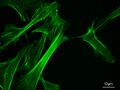 MEF microfilaments


Medical Disclaimer: WikiMD is for informational purposes only and is not a substitute for professional medical advice. Content may be inaccurate or outdated and should not be used for diagnosis or treatment. Always consult your healthcare provider for medical decisions. Verify information with trusted sources such as CDC.gov and NIH.gov. By using this site, you agree that WikiMD is not liable for any outcomes related to its content. See full disclaimer.
Credits:Most images are courtesy of Wikimedia commons, and templates, categories Wikipedia, licensed under CC BY SA or similar.
Translate page: - East Asian
中文,
日本,
한국어,
South Asian
हिन्दी,
தமிழ்,
తెలుగు,
Urdu,
ಕನ್ನಡ,
Southeast Asian
Indonesian,
Vietnamese,
Thai,
မြန်မာဘာသာ,
বাংলা
European
español,
Deutsch,
français,
Greek,
português do Brasil,
polski,
română,
русский,
Nederlands,
norsk,
svenska,
suomi,
Italian
Middle Eastern & African
عربى,
Turkish,
Persian,
Hebrew,
Afrikaans,
isiZulu,
Kiswahili,
Other
Bulgarian,
Hungarian,
Czech,
Swedish,
മലയാളം,
मराठी,
ਪੰਜਾਬੀ,
ગુજરાતી,
Portuguese,
Ukrainian

