Acid phosphatase
Enzyme that catalyzes the hydrolysis of phosphate esters in an acidic environment
Acid phosphatase is an enzyme that catalyzes the hydrolysis of phosphate esters in an acidic environment. It is found in many tissues and is involved in the breakdown of phosphomonoesters to release inorganic phosphate and alcohol. Acid phosphatase is important in various biological processes, including bone resorption and the digestion of dietary phosphates.
Structure[edit]
Acid phosphatase is a lysosomal enzyme that is typically a glycoprotein. It is composed of a single polypeptide chain and contains several glycosylation sites. The enzyme has a characteristic three-dimensional structure that includes a catalytic site where the hydrolysis reaction occurs. The structure of acid phosphatase can vary slightly depending on the tissue from which it is derived.
Function[edit]
The primary function of acid phosphatase is to hydrolyze phosphate esters at an acidic pH, typically around pH 4.8 to 5.0. This enzyme is involved in the dephosphorylation of various substrates, which is crucial for many cellular processes. In the prostate gland, acid phosphatase is secreted into the seminal fluid, where it plays a role in the liquefaction of semen.
Clinical significance[edit]
Acid phosphatase levels can be measured in the blood and are used as a diagnostic marker for certain medical conditions. Elevated levels of acid phosphatase in the blood can indicate prostate cancer, as the enzyme is released into the bloodstream when prostate cells are damaged. It can also be elevated in other conditions such as Paget's disease, hyperparathyroidism, and Gaucher's disease.
Measurement[edit]
The measurement of acid phosphatase activity in the blood is performed using a colorimetric assay, where the enzyme's activity is determined by the rate of conversion of a substrate to a colored product. This assay is sensitive to the pH and temperature of the reaction, and it is important to maintain optimal conditions for accurate results.
Related pages[edit]
Gallery[edit]
-
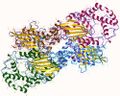 Structure of acid phosphatase
 -
 Blood values sorted by mass and molar concentration


Medical Disclaimer: WikiMD is for informational purposes only and is not a substitute for professional medical advice. Content may be inaccurate or outdated and should not be used for diagnosis or treatment. Always consult your healthcare provider for medical decisions. Verify information with trusted sources such as CDC.gov and NIH.gov. By using this site, you agree that WikiMD is not liable for any outcomes related to its content. See full disclaimer.
Credits:Most images are courtesy of Wikimedia commons, and templates, categories Wikipedia, licensed under CC BY SA or similar.
Translate page: - East Asian
中文,
日本,
한국어,
South Asian
हिन्दी,
தமிழ்,
తెలుగు,
Urdu,
ಕನ್ನಡ,
Southeast Asian
Indonesian,
Vietnamese,
Thai,
မြန်မာဘာသာ,
বাংলা
European
español,
Deutsch,
français,
Greek,
português do Brasil,
polski,
română,
русский,
Nederlands,
norsk,
svenska,
suomi,
Italian
Middle Eastern & African
عربى,
Turkish,
Persian,
Hebrew,
Afrikaans,
isiZulu,
Kiswahili,
Other
Bulgarian,
Hungarian,
Czech,
Swedish,
മലയാളം,
मराठी,
ਪੰਜਾਬੀ,
ગુજરાતી,
Portuguese,
Ukrainian

