Abductor hallucis muscle
The abductor hallucis muscle is a muscle located in the foot. It plays a crucial role in the movement and stabilization of the big toe, also known as the hallux.
Anatomy[edit]
The abductor hallucis muscle is situated along the medial side of the foot. It originates from the medial process of the calcaneal tuberosity, the flexor retinaculum, and the plantar aponeurosis. The muscle fibers run along the medial side of the foot and insert into the medial side of the base of the proximal phalanx of the big toe.
Function[edit]
The primary function of the abductor hallucis muscle is to abduct the big toe, moving it away from the second toe. This action is important for maintaining balance and stability during walking and running. Additionally, the muscle assists in flexing the big toe and supports the medial longitudinal arch of the foot.
Innervation[edit]
The abductor hallucis muscle is innervated by the medial plantar nerve, which is a branch of the tibial nerve.
Blood Supply[edit]
The blood supply to the abductor hallucis muscle is provided by the medial plantar artery, a branch of the posterior tibial artery.
Clinical Significance[edit]
Weakness or dysfunction of the abductor hallucis muscle can lead to conditions such as hallux valgus or flatfoot. Strengthening exercises and proper footwear can help maintain the function of this muscle and prevent such conditions.
Related pages[edit]
Gallery[edit]
-
Illustration of the abductor hallucis muscle.
-
 Intrinsic muscles of the foot, including the abductor hallucis.
 -
Detailed view of the abductor hallucis muscle.
-
Muscles in the human foot, seen from below.
-
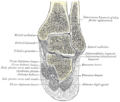 Anatomical diagram showing the abductor hallucis muscle.


Advertise on WikiMD — 81,000+ full articles, ~900,000 total pages, ~250 million page views. Global reach, limited time promotional rates from $1/page/day. Learn more · View stats

Translate page: - East Asian
中文,
日本,
한국어,
South Asian
हिन्दी,
தமிழ்,
తెలుగు,
Urdu,
ಕನ್ನಡ,
Southeast Asian
Indonesian,
Vietnamese,
Thai,
မြန်မာဘာသာ,
বাংলা
European
español,
Deutsch,
français,
Greek,
português do Brasil,
polski,
română,
русский,
Nederlands,
norsk,
svenska,
suomi,
Italian
Middle Eastern & African
عربى,
Turkish,
Persian,
Hebrew,
Afrikaans,
isiZulu,
Kiswahili,
Other
Bulgarian,
Hungarian,
Czech,
Swedish,
മലയാളം,
मराठी,
ਪੰਜਾਬੀ,
ગુજરાતી,
Portuguese,
Ukrainian
About WikiMD • Contact • Disclaimer • Privacy • Copyright • Site statistics
Some content and images may originate from Wikimedia Commons or Wikipedia and remain subject to their stated licenses. Unless otherwise noted, eligible WikiMD content is available under CC BY-SA 4.0.
WikiMD Wellnesspedia — Free health & wellness information for patients, students, and health professionals.


.jpg)