7-Aminoactinomycin D
A fluorescent dye used in cell biology
7-Aminoactinomycin D (7-AAD) is a fluorescent chemical compound used in cell biology for DNA staining. It is a derivative of actinomycin D, a compound that binds to DNA. 7-AAD is commonly used in flow cytometry to assess cell viability and to distinguish between live and dead cells.
Properties[edit]
7-AAD is a red fluorescent dye that intercalates into double-stranded DNA. It has an excitation maximum at approximately 546 nm and an emission maximum at approximately 647 nm. Due to its spectral properties, 7-AAD is often used in combination with other fluorescent dyes in multicolor flow cytometry experiments.
Applications[edit]
7-AAD is primarily used in flow cytometry to evaluate cell viability. It is excluded by live cells with intact membranes but can penetrate and stain dead or dying cells with compromised membranes. This makes it a valuable tool for distinguishing between live and dead cells in a sample.
Flow Cytometry[edit]
In flow cytometry, 7-AAD is used to stain cells in a suspension. The cells are then passed through a laser beam, and the fluorescence emitted by 7-AAD is detected. This allows researchers to quantify the proportion of dead cells in a sample. 7-AAD is often used in conjunction with other viability dyes, such as propidium iodide, to provide a more comprehensive analysis of cell viability.
Advantages and Limitations[edit]
7-AAD is advantageous because it provides a clear distinction between live and dead cells based on membrane integrity. However, it cannot be used to stain live cells, as it is impermeable to intact cell membranes. Additionally, 7-AAD can be phototoxic, so care must be taken to minimize light exposure during experiments.
Related pages[edit]
Gallery[edit]
-
 Flow cytometric analysis using 7-AAD
 -
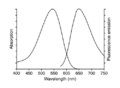 Spectral properties of 7-AAD


7-Aminoactinomycin_D[edit]

Medical Disclaimer: WikiMD is for informational purposes only and is not a substitute for professional medical advice. Content may be inaccurate or outdated and should not be used for diagnosis or treatment. Always consult your healthcare provider for medical decisions. Verify information with trusted sources such as CDC.gov and NIH.gov. By using this site, you agree that WikiMD is not liable for any outcomes related to its content. See full disclaimer.
Credits:Most images are courtesy of Wikimedia commons, and templates, categories Wikipedia, licensed under CC BY SA or similar.
Translate page: - East Asian
中文,
日本,
한국어,
South Asian
हिन्दी,
தமிழ்,
తెలుగు,
Urdu,
ಕನ್ನಡ,
Southeast Asian
Indonesian,
Vietnamese,
Thai,
မြန်မာဘာသာ,
বাংলা
European
español,
Deutsch,
français,
Greek,
português do Brasil,
polski,
română,
русский,
Nederlands,
norsk,
svenska,
suomi,
Italian
Middle Eastern & African
عربى,
Turkish,
Persian,
Hebrew,
Afrikaans,
isiZulu,
Kiswahili,
Other
Bulgarian,
Hungarian,
Czech,
Swedish,
മലയാളം,
मराठी,
ਪੰਜਾਬੀ,
ગુજરાતી,
Portuguese,
Ukrainian

