Clavicle fracture

Editor-In-Chief: Prab R Tumpati, MD
Obesity, Sleep & Internal medicine
Founder, WikiMD Wellnesspedia &
W8MD's medical weight loss NYC, sleep center NYC
Philadelphia medical weight loss and Philadelphia sleep clinics
| Clavicle fracture | |
|---|---|
 | |
| Synonyms | Broken collarbone |
| Pronounce | N/A |
| Specialty | N/A |
| Symptoms | Pain, swelling, bruising, deformity |
| Complications | Pneumothorax, neurovascular injury, nonunion |
| Onset | Sudden |
| Duration | Weeks to months |
| Types | N/A |
| Causes | Trauma, falls, sports injuries |
| Risks | Contact sports, bicycle accidents, motor vehicle collisions |
| Diagnosis | Physical examination, X-ray |
| Differential diagnosis | Acromioclavicular joint injury, shoulder dislocation |
| Prevention | N/A |
| Treatment | Sling, physical therapy, surgery |
| Medication | Analgesics |
| Prognosis | Generally good with treatment |
| Frequency | Common |
| Deaths | N/A |
Clavicle Fracture
A clavicle fracture, also known as a broken collarbone, is a common injury that occurs in the clavicle, one of the main bones in the shoulder. This type of fracture typically results from a direct blow to the shoulder, such as during a fall or a sports-related injury.
Causes[edit]
The most common cause of a clavicle fracture is a fall onto the shoulder or an outstretched arm. This can occur during various activities, such as cycling, football, and skiing. Other causes can include car accidents and, in newborns, the passage through the birth canal.
Symptoms[edit]
The main symptoms of a clavicle fracture include pain, swelling, and an inability to move the arm. There may also be a noticeable deformity or bump over the break. Bruising, tenderness, and a grinding sensation when the arm is moved are also common.
Diagnosis[edit]
A clavicle fracture is usually diagnosed through a physical examination and imaging tests, such as X-rays. In some cases, a CT scan may be used to provide more detailed images.
Treatment[edit]
Treatment for a clavicle fracture often depends on the nature of the fracture. Non-surgical treatment options include the use of a sling to immobilize the arm, pain medication, and physical therapy. Surgical treatment may be required for more severe fractures and can involve the use of plates, screws, or pins to hold the bone in place while it heals.
Prognosis[edit]
With appropriate treatment, most people with a clavicle fracture can expect to make a full recovery. However, complications can occur, including nerve or blood vessel damage, infection, and nonunion of the fracture.
Gallery[edit]
-
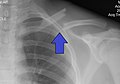 Clavicle fracture on the left side
 -
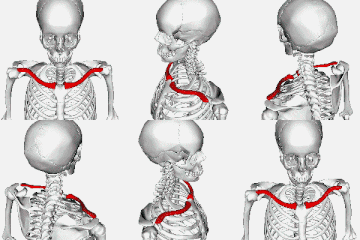 Animated depiction of a clavicle fracture
 -
 Illustration of a clavicle fracture
 -
 Post-operative image of a clavicle fracture


See also[edit]
This article is a Orthopedic stub. You can help WikiMD by expanding it!
Ad. Transform your health with W8MD Weight Loss, Sleep & MedSpa

Tired of being overweight?
Special offer:
Budget GLP-1 weight loss medications
- Semaglutide starting from $29.99/week and up with insurance for visit of $59.99 and up per week self pay.
- Tirzepatide starting from $45.00/week and up (dose dependent) or $69.99/week and up self pay
✔ Same-week appointments, evenings & weekends
Learn more:
- GLP-1 weight loss clinic NYC
- W8MD's NYC medical weight loss
- W8MD Philadelphia GLP-1 shots
- Philadelphia GLP-1 injections
- Affordable GLP-1 shots NYC
|
WikiMD Medical Encyclopedia |
Medical Disclaimer: WikiMD is for informational purposes only and is not a substitute for professional medical advice. Content may be inaccurate or outdated and should not be used for diagnosis or treatment. Always consult your healthcare provider for medical decisions. Verify information with trusted sources such as CDC.gov and NIH.gov. By using this site, you agree that WikiMD is not liable for any outcomes related to its content. See full disclaimer.
Credits:Most images are courtesy of Wikimedia commons, and templates, categories Wikipedia, licensed under CC BY SA or similar.
Translate this page: - East Asian
中文,
日本,
한국어,
South Asian
हिन्दी,
தமிழ்,
తెలుగు,
Urdu,
ಕನ್ನಡ,
Southeast Asian
Indonesian,
Vietnamese,
Thai,
မြန်မာဘာသာ,
বাংলা
European
español,
Deutsch,
français,
Greek,
português do Brasil,
polski,
română,
русский,
Nederlands,
norsk,
svenska,
suomi,
Italian
Middle Eastern & African
عربى,
Turkish,
Persian,
Hebrew,
Afrikaans,
isiZulu,
Kiswahili,
Other
Bulgarian,
Hungarian,
Czech,
Swedish,
മലയാളം,
मराठी,
ਪੰਜਾਬੀ,
ગુજરાતી,
Portuguese,
Ukrainian
