Baldwin effect
Baldwin Effect
The Baldwin effect, also known as Baldwinian evolution, is a theory proposed in the late 19th century by American psychologist James Mark Baldwin. It suggests an evolutionary process whereby learned behaviors can, over time, become encoded in an organism's genetic material through the mechanism of natural selection. This concept bridges the gap between inheritance of acquired characteristics and Darwinian evolution, providing a plausible explanation for how organisms adapt to their environments more rapidly than could be accounted for by genetic mutation alone.
Overview[edit]
The Baldwin effect posits that individuals in a population who are capable of learning new behaviors can gain a selective advantage over those who cannot. These behaviors, while not directly encoded in the genome, can lead to changes in the environment or in the behavior of the organism that may affect the selection pressures acting on the population. Over generations, these pressures can lead to genetic changes that support the learned behavior, making it less reliant on learning and more a matter of instinctual behavior.
Mechanism[edit]
The process involves several key steps:
- An individual organism learns a behavior that gives it a survival or reproductive advantage.
- This advantage leads to greater reproductive success for those individuals who can learn the behavior.
- Over time, genetic mutations that support this advantageous behavior increase in frequency within the population through natural selection.
- Eventually, the behavior becomes less about learning and more a genetically predisposed trait.
Implications[edit]
The Baldwin effect has significant implications for understanding the evolution of complex behaviors and traits, particularly those that seem to appear more rapidly than would be expected through genetic mutation alone. It provides a mechanism for the integration of environmental factors and phenotypic plasticity into evolutionary theory, suggesting a more dynamic interaction between organisms and their environments.
Criticism and Support[edit]
The concept has been both supported and criticized by scientists. Critics argue that the Baldwin effect cannot account for the initial appearance of advantageous traits through learning, nor does it explain how these traits become genetically encoded. Supporters, however, contend that the Baldwin effect complements traditional evolutionary theory by providing a mechanism for the rapid development and fixation of advantageous traits.
Examples[edit]
One often-cited example of the Baldwin effect is the development of lactose tolerance in human populations. Initially, the ability to digest lactose beyond infancy was not common. However, with the domestication of cattle and the advent of dairy farming, individuals who could digest lactose had a nutritional advantage. Over generations, this led to an increase in the frequency of genes associated with lactose tolerance.
See Also[edit]
References[edit]
<references/>
 | This medical article is a stub. You can help Wikipedia by adding missing information. |
-
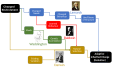 Lamarck Compared to Darwin, Baldwin, Waddington
 -
 Carpodacus mexicanus - Madison, Wisconsin, USA


Ad. Transform your health with W8MD Weight Loss, Sleep & MedSpa

Tired of being overweight?
Special offer:
Budget GLP-1 weight loss medications
- Semaglutide starting from $29.99/week and up with insurance for visit of $59.99 and up per week self pay.
- Tirzepatide starting from $45.00/week and up (dose dependent) or $69.99/week and up self pay
✔ Same-week appointments, evenings & weekends ✔ Tele visits available with certain limitations Learn more:
- GLP-1 weight loss clinic NYC
- W8MD's NYC medical weight loss
- W8MD Philadelphia GLP-1 shots
- Philadelphia GLP-1 injections
- Affordable GLP-1 shots NYC
- Budget GLP-1 shots
|
WikiMD Medical Encyclopedia |
Medical Disclaimer: WikiMD is for informational purposes only and is not a substitute for professional medical advice. Content may be inaccurate or outdated and should not be used for diagnosis or treatment. Always consult your healthcare provider for medical decisions. Verify information with trusted sources such as CDC.gov and NIH.gov. By using this site, you agree that WikiMD is not liable for any outcomes related to its content. See full disclaimer.
Credits:Most images are courtesy of Wikimedia commons, and templates, categories Wikipedia, licensed under CC BY SA or similar.
Translate this page: - East Asian
中文,
日本,
한국어,
South Asian
हिन्दी,
தமிழ்,
తెలుగు,
Urdu,
ಕನ್ನಡ,
Southeast Asian
Indonesian,
Vietnamese,
Thai,
မြန်မာဘာသာ,
বাংলা
European
español,
Deutsch,
français,
Greek,
português do Brasil,
polski,
română,
русский,
Nederlands,
norsk,
svenska,
suomi,
Italian
Middle Eastern & African
عربى,
Turkish,
Persian,
Hebrew,
Afrikaans,
isiZulu,
Kiswahili,
Other
Bulgarian,
Hungarian,
Czech,
Swedish,
മലയാളം,
मराठी,
ਪੰਜਾਬੀ,
ગુજરાતી,
Portuguese,
Ukrainian
