Phytoplankton
Phytoplankton are the autotrophic (self-feeding) components of the plankton community and a key part of oceans, seas and freshwater basin ecosystems. The name comes from the Greek words φυτόν (phyton), meaning 'plant', and πλαγκτός (planktos), meaning 'wanderer' or 'drifter'.
Phytoplankton obtain energy through the process of photosynthesis and must therefore live in the well-lit surface layer (termed the euphotic zone) of an ocean, sea, lake, or other body of water. They account for about half of all photosynthetic activity on Earth.
Classification[edit]
Phytoplankton encompass a wide array of unicellular organisms, some of which are no longer classified within the plant kingdom. They can be broadly divided into two groups: cyanobacteria (also called blue-green algae) and algae.
Role in the food chain[edit]
Phytoplankton serve as the base of the aquatic food web, providing an essential ecological function for all aquatic life. They are consumed by zooplankton, small fish and whales.
Role in the carbon cycle[edit]
Phytoplankton play a crucial role in the carbon cycle, they take in carbon dioxide, and release oxygen as a by-product, which other organisms, such as humans, depend on for survival.
Threats[edit]
Phytoplankton populations can be negatively impacted by climate change, ocean acidification, and water pollution. These threats can lead to algal blooms, which can have harmful effects on other marine life and the environment.
See also[edit]
 | |
|---|---|
 |
 |
Phytoplankton[edit]
-
 Diatoms through the microscope
 -
 A bluegreen algae species Cylindrospermum sp under magnification
 -
 Global phytoplankton distribution - NASA
 -
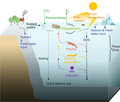 Cycling of marine phytoplankton
 -
 Luminescent beaches in Chabahar
 -
 Spring Bloom Colors the Pacific Near Hokkaido
 -
 Cwall99
 -
 NASA satellite view of Southern Ocean phytoplankton bloom
 -
 Competing scientific hypothesis of plankton variability
 -
 Plankton satellite image
 -
 Global phytoplankton species richness and turnover


.jpg)


Ad. Transform your health with W8MD Weight Loss, Sleep & MedSpa

Tired of being overweight?
Special offer:
Budget GLP-1 weight loss medications
- Semaglutide starting from $29.99/week and up with insurance for visit of $59.99 and up per week self pay.
- Tirzepatide starting from $45.00/week and up (dose dependent) or $69.99/week and up self pay
✔ Same-week appointments, evenings & weekends
Learn more:
- GLP-1 weight loss clinic NYC
- W8MD's NYC medical weight loss
- W8MD Philadelphia GLP-1 shots
- Philadelphia GLP-1 injections
- Affordable GLP-1 shots NYC
- Budget GLP-1 shots
|
WikiMD Medical Encyclopedia |
Medical Disclaimer: WikiMD is for informational purposes only and is not a substitute for professional medical advice. Content may be inaccurate or outdated and should not be used for diagnosis or treatment. Always consult your healthcare provider for medical decisions. Verify information with trusted sources such as CDC.gov and NIH.gov. By using this site, you agree that WikiMD is not liable for any outcomes related to its content. See full disclaimer.
Credits:Most images are courtesy of Wikimedia commons, and templates, categories Wikipedia, licensed under CC BY SA or similar.
Translate this page: - East Asian
中文,
日本,
한국어,
South Asian
हिन्दी,
தமிழ்,
తెలుగు,
Urdu,
ಕನ್ನಡ,
Southeast Asian
Indonesian,
Vietnamese,
Thai,
မြန်မာဘာသာ,
বাংলা
European
español,
Deutsch,
français,
Greek,
português do Brasil,
polski,
română,
русский,
Nederlands,
norsk,
svenska,
suomi,
Italian
Middle Eastern & African
عربى,
Turkish,
Persian,
Hebrew,
Afrikaans,
isiZulu,
Kiswahili,
Other
Bulgarian,
Hungarian,
Czech,
Swedish,
മലയാളം,
मराठी,
ਪੰਜਾਬੀ,
ગુજરાતી,
Portuguese,
Ukrainian
