Triethylenetetramine
A chelating agent used in the treatment of Wilson's disease
Triethylenetetramine, also known as TETA, is a chelating agent primarily used in the treatment of Wilson's disease, a genetic disorder that leads to excessive accumulation of copper in the body. TETA works by binding to copper, facilitating its excretion from the body, and thereby reducing copper toxicity.
Chemical Properties[edit]
Triethylenetetramine is an organic compound with the formula C6H18N4. It is a colorless to pale yellow liquid with a fishy odor, characteristic of amines. TETA is a polyamine, containing four amine groups, which contribute to its ability to chelate metal ions.
Mechanism of Action[edit]
TETA acts as a chelating agent by binding to copper ions in the bloodstream. The complex formed between TETA and copper is more water-soluble than free copper ions, allowing it to be excreted through the urinary system. This process helps to lower copper levels in patients with Wilson's disease, preventing damage to organs such as the liver and brain.
Medical Uses[edit]
Wilson's Disease[edit]
Wilson's disease is an autosomal recessive disorder characterized by the accumulation of copper in tissues, leading to hepatic and neurological symptoms. TETA is used as a second-line treatment for patients who cannot tolerate penicillamine, the first-line therapy. It is particularly useful in patients with neurological symptoms, as it is less likely to exacerbate these symptoms compared to penicillamine.
Other Potential Uses[edit]
Research is ongoing into the use of TETA for other conditions involving metal ion dysregulation, such as certain types of cancer and cardiovascular disease. However, these uses are not yet established in clinical practice.
Side Effects[edit]
Common side effects of TETA include gastrointestinal disturbances such as nausea and diarrhea. Some patients may experience allergic reactions, including skin rashes. Long-term use requires monitoring of blood counts and liver function tests to detect potential toxicity.
Pharmacokinetics[edit]
TETA is administered orally and is absorbed through the gastrointestinal tract. It is metabolized in the liver and excreted primarily in the urine. The half-life of TETA allows for dosing typically twice daily, although this may vary based on individual patient needs and response.
Synthesis[edit]
The synthesis of triethylenetetramine involves the reaction of ethylene dichloride with ammonia, followed by further reaction with ethyleneimine. This process yields a mixture of polyamines, from which TETA can be isolated and purified.
Safety and Handling[edit]
TETA should be handled with care, as it can cause skin and eye irritation. Appropriate personal protective equipment, such as gloves and goggles, should be used when handling the compound. In case of contact with skin or eyes, the affected area should be rinsed thoroughly with water.
Related Pages[edit]
Triethylenetetramine[edit]
-
 Triethylenetetramine chemical structure
 -
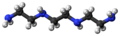 Triethylenetetramine 3D ball model
 -
 Triethylenetetramine 3D space-filling model
bis(ethane-1,2-diamine)_200.svg)


Ad. Transform your life with W8MD's
GLP-1 weight loss injections special from $29.99 with insurance
|
WikiMD Medical Encyclopedia |
Medical Disclaimer: WikiMD is for informational purposes only and is not a substitute for professional medical advice. Content may be inaccurate or outdated and should not be used for diagnosis or treatment. Always consult your healthcare provider for medical decisions. Verify information with trusted sources such as CDC.gov and NIH.gov. By using this site, you agree that WikiMD is not liable for any outcomes related to its content. See full disclaimer.
Credits:Most images are courtesy of Wikimedia commons, and templates, categories Wikipedia, licensed under CC BY SA or similar.
Translate this page: - East Asian
中文,
日本,
한국어,
South Asian
हिन्दी,
தமிழ்,
తెలుగు,
Urdu,
ಕನ್ನಡ,
Southeast Asian
Indonesian,
Vietnamese,
Thai,
မြန်မာဘာသာ,
বাংলা
European
español,
Deutsch,
français,
Greek,
português do Brasil,
polski,
română,
русский,
Nederlands,
norsk,
svenska,
suomi,
Italian
Middle Eastern & African
عربى,
Turkish,
Persian,
Hebrew,
Afrikaans,
isiZulu,
Kiswahili,
Other
Bulgarian,
Hungarian,
Czech,
Swedish,
മലയാളം,
मराठी,
ਪੰਜਾਬੀ,
ગુજરાતી,
Portuguese,
Ukrainian
