Carpaccio
Carpaccio


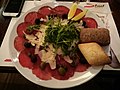
Carpaccio is a traditional Italian appetizer consisting of thin slices of raw beef dressed with lemon juice, olive oil, and white truffles or Parmesan cheese. Originating from Venice, Italy, the dish was invented in the 1950s by Giuseppe Cipriani, the founder of Harry's Bar in Venice, for a countess whose doctors recommended she eat raw meat. The dish is named after Vittore Carpaccio, a Venetian painter known for his use of vibrant reds, reflecting the color of the raw meat.
History[edit]
The creation of carpaccio is attributed to Giuseppe Cipriani at the renowned Harry's Bar in Venice during the mid-20th century. It was specifically prepared for Countess Amalia Nani Mocenigo when she informed Cipriani that her doctor had recommended a diet of raw meat. The dish was named after the painter Vittore Carpaccio, as the red hues of the meat were reminiscent of the reds found in Carpaccio's artwork.
Ingredients and Preparation[edit]
Carpaccio is traditionally made with high-quality, lean beef such as sirloin, which is frozen slightly to facilitate thin slicing. The beef slices are then laid out on a plate and typically seasoned with lemon juice, olive oil, salt, and freshly ground black pepper. The dish is garnished with shavings of white truffle or Parmesan cheese, and sometimes capers and onions. Modern variations of carpaccio include using fish such as salmon or tuna, and even vegetarian versions using fruits and vegetables like zucchini or beetroot.
Cultural Significance[edit]
Carpaccio has become a staple of Italian antipasti menus and has gained international popularity. Its simplicity, combined with the elegance of its presentation, embodies the Italian culinary philosophy of using high-quality, fresh ingredients to create flavorful dishes. Carpaccio's invention also reflects the adaptability of Italian cuisine, incorporating dietary needs and local art history into its creation.
Variations[edit]
While beef carpaccio remains the most traditional and recognized form, variations of the dish now include:
- Fish Carpaccio: Thin slices of raw fish, typically salmon or tuna, dressed with lemon juice and olive oil.
- Vegetable Carpaccio: Thin slices of raw vegetables such as zucchini, beetroot, or radishes, often served with a vinaigrette dressing.
See Also[edit]

-
 Carpaccio

Ad. Transform your health with W8MD Weight Loss, Sleep & MedSpa

Tired of being overweight?
Special offer:
Budget GLP-1 weight loss medications
- Semaglutide starting from $29.99/week and up with insurance for visit of $59.99 and up per week self pay.
- Tirzepatide starting from $45.00/week and up (dose dependent) or $69.99/week and up self pay
✔ Same-week appointments, evenings & weekends
Learn more:
- GLP-1 weight loss clinic NYC
- W8MD's NYC medical weight loss
- W8MD Philadelphia GLP-1 shots
- Philadelphia GLP-1 injections
- Affordable GLP-1 shots NYC
|
WikiMD Medical Encyclopedia |
Medical Disclaimer: WikiMD is for informational purposes only and is not a substitute for professional medical advice. Content may be inaccurate or outdated and should not be used for diagnosis or treatment. Always consult your healthcare provider for medical decisions. Verify information with trusted sources such as CDC.gov and NIH.gov. By using this site, you agree that WikiMD is not liable for any outcomes related to its content. See full disclaimer.
Credits:Most images are courtesy of Wikimedia commons, and templates, categories Wikipedia, licensed under CC BY SA or similar.
Translate this page: - East Asian
中文,
日本,
한국어,
South Asian
हिन्दी,
தமிழ்,
తెలుగు,
Urdu,
ಕನ್ನಡ,
Southeast Asian
Indonesian,
Vietnamese,
Thai,
မြန်မာဘာသာ,
বাংলা
European
español,
Deutsch,
français,
Greek,
português do Brasil,
polski,
română,
русский,
Nederlands,
norsk,
svenska,
suomi,
Italian
Middle Eastern & African
عربى,
Turkish,
Persian,
Hebrew,
Afrikaans,
isiZulu,
Kiswahili,
Other
Bulgarian,
Hungarian,
Czech,
Swedish,
മലയാളം,
मराठी,
ਪੰਜਾਬੀ,
ગુજરાતી,
Portuguese,
Ukrainian
