Zhajiangmian
A traditional Chinese noodle dish
Zhajiangmian (Chinese: ___; pinyin: zhájiàngmiàn
) is a popular Chinese noodle dish that originates from Beijing. The name literally translates to "fried sauce noodles," which reflects the method of preparation and the key ingredient used in the dish. It is a staple in Northern Chinese cuisine and has various regional adaptations.
Ingredients[edit]
The primary components of zhajiangmian include:
- Noodles: Typically, thick wheat noodles are used, which are boiled until they reach a chewy texture.
- Zhajiang sauce: The sauce is made from fermented soybean paste, often combined with ground pork or beef. The paste is fried in oil, which enhances its flavor and gives the dish its characteristic taste.
- Vegetables: Commonly used vegetables include cucumber, carrot, and bean sprouts, which are julienned and served fresh to add a crunchy texture.
- Garnishes: Chopped scallions and garlic are often used as garnishes to add freshness and aroma.
Preparation[edit]
The preparation of zhajiangmian involves several steps:
1. Cooking the Noodles: The wheat noodles are boiled in water until they are al dente. They are then drained and set aside.
2. Making the Sauce: The fermented soybean paste is fried in oil, and ground meat is added. The mixture is cooked until the meat is browned and the flavors meld together. Sometimes, additional ingredients like ginger or rice wine are added to enhance the flavor.
3. Assembling the Dish: The cooked noodles are placed in a bowl, topped with the zhajiang sauce, and garnished with fresh vegetables and scallions.
Regional Variations[edit]
While zhajiangmian is most closely associated with Beijing, it has several regional variations:
- In Shandong, the sauce may include seafood, reflecting the coastal influence.
- In Korea, a similar dish called Jajangmyeon is popular, which uses a black bean paste and often includes seafood or vegetables.
- In Taiwan, the dish might be sweeter, with the addition of sugar or sweet bean paste.
Cultural Significance[edit]
Zhajiangmian is more than just a dish; it is a cultural symbol in Northern China. It is often served during family gatherings and celebrations. The dish's simplicity and rich flavor make it a comfort food for many.
Related pages[edit]
-
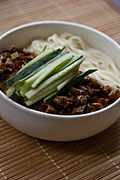 Zhajiangmian
 -
 Noodles with soy bean paste
 -
 Ho To Tai noodles
 -
 Zhajiangmian and bibimbap in Japan
 -
 Taste of Beijing, Soho, London
 -
 Zhajiangmian Noodles, Fresh Noodles, Paris
 -
 Zhajiangmian noodles at Noodle Factory, Chinatown, Montréal
 -
 Wei Lih Zha Jiang Mian


.jpg)

.jpg)

Ad. Transform your life with W8MD's
GLP-1 weight loss injections special from $29.99


W8MD Medical Weight Loss, Sleep and Medspa offers physician-supervised medical weight loss programs: NYC medical weight loss Philadelphia medical weight loss
Affordable GLP-1 Weight Loss ShotsAffordable GLP-1 Weight Loss Shots
Budget GLP-1 injections NYC (insurance & self-pay options) Popular treatments:
- Semaglutide starting from $29.99/week
- Tirzepatide starting from $45.00/week
✔ Most insurances accepted for visits ✔ Prior authorization support when eligible
Start your physician weight loss NYC journey today:
📍 NYC: Brooklyn weight loss center 📍 Philadelphia: Philadelphia weight loss center
📞 Call: 718-946-5500 (NYC) | 215-676-2334 (Philadelphia)
Tags: Affordable GLP1 weight loss NYC, Wegovy NYC, Zepbound NYC, Philadelphia medical weight loss


|
WikiMD Medical Encyclopedia |
Medical Disclaimer: WikiMD is not a substitute for professional medical advice. The information on WikiMD is provided as an information resource only, may be incorrect, outdated or misleading, and is not to be used or relied on for any diagnostic or treatment purposes. Please consult your health care provider before making any healthcare decisions or for guidance about a specific medical condition. WikiMD expressly disclaims responsibility, and shall have no liability, for any damages, loss, injury, or liability whatsoever suffered as a result of your reliance on the information contained in this site. By visiting this site you agree to the foregoing terms and conditions, which may from time to time be changed or supplemented by WikiMD. If you do not agree to the foregoing terms and conditions, you should not enter or use this site. See full disclaimer.
Credits:Most images are courtesy of Wikimedia commons, and templates, categories Wikipedia, licensed under CC BY SA or similar.
Translate this page: - East Asian
中文,
日本,
한국어,
South Asian
हिन्दी,
தமிழ்,
తెలుగు,
Urdu,
ಕನ್ನಡ,
Southeast Asian
Indonesian,
Vietnamese,
Thai,
မြန်မာဘာသာ,
বাংলা
European
español,
Deutsch,
français,
Greek,
português do Brasil,
polski,
română,
русский,
Nederlands,
norsk,
svenska,
suomi,
Italian
Middle Eastern & African
عربى,
Turkish,
Persian,
Hebrew,
Afrikaans,
isiZulu,
Kiswahili,
Other
Bulgarian,
Hungarian,
Czech,
Swedish,
മലയാളം,
मराठी,
ਪੰਜਾਬੀ,
ગુજરાતી,
Portuguese,
Ukrainian
