Amaranthus spinosus
-
 Amaranthus spinosus plant
 -
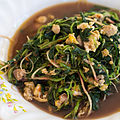 Phat phak khom dish
 -
 Cenex gas station in Gillette, Wyoming


Amaranthus spinosus[edit]
Amaranthus spinosus, commonly known as spiny amaranth or thorny amaranth, is a species of annual plant in the Amaranthaceae family. It is native to the tropical regions of the Americas but has become a widespread weed in many parts of the world.
Description[edit]
Amaranthus spinosus is characterized by its erect, branching stems that can grow up to 1.5 meters tall. The plant is easily identified by its sharp spines located at the base of the leaves. The leaves are simple, alternate, and have a lanceolate to ovate shape with a smooth margin. The plant produces small, greenish flowers that are arranged in dense clusters known as inflorescences. These inflorescences are typically found at the terminal ends of the stems and in the leaf axils.
Habitat and Distribution[edit]
Amaranthus spinosus thrives in a variety of habitats, including agricultural fields, gardens, roadsides, and waste areas. It prefers warm and humid environments and is commonly found in tropical and subtropical regions. The plant has been introduced to many parts of the world, including Africa, Asia, and Australia, where it is often considered an invasive species.
Ecological Impact[edit]
As a weed, Amaranthus spinosus can compete with crops for nutrients, water, and light, potentially reducing agricultural yield. Its presence in crop fields can also complicate harvesting and management practices. The plant's ability to produce a large number of seeds contributes to its rapid spread and persistence in disturbed environments.
Uses[edit]
Despite its status as a weed, Amaranthus spinosus has several uses. In some cultures, the young leaves and stems are consumed as a leafy vegetable. The plant is also used in traditional medicine for its purported anti-inflammatory, diuretic, and antipyretic properties. However, care should be taken when using the plant for medicinal purposes, as it may contain nitrates and oxalates that can be harmful in large quantities.
Control and Management[edit]
Controlling Amaranthus spinosus involves a combination of mechanical, chemical, and cultural methods. Mechanical control includes hand pulling or hoeing before the plant sets seed. Chemical control involves the use of herbicides, although resistance to certain herbicides has been reported. Cultural control strategies include maintaining healthy crop stands and using mulches to suppress weed growth.
Related Pages[edit]
Ad. Transform your health with W8MD Weight Loss, Sleep & MedSpa

Tired of being overweight?
Get started with evidence based, physician-supervised
affordable GLP-1 weight loss injections
Now available in New York City and Philadelphia:
- Semaglutide starting from $59.99/week and up
- Tirzepatide starting from $69.99/week and up (dose dependent)
✔ Evidence-based medical weight loss ✔ Insurance-friendly visits available ✔ Same-week appointments, evenings & weekends
Learn more:
Start your transformation today with W8MD weight loss centers.
|
WikiMD Medical Encyclopedia |
Medical Disclaimer: WikiMD is for informational purposes only and is not a substitute for professional medical advice. Content may be inaccurate or outdated and should not be used for diagnosis or treatment. Always consult your healthcare provider for medical decisions. Verify information with trusted sources such as CDC.gov and NIH.gov. By using this site, you agree that WikiMD is not liable for any outcomes related to its content. See full disclaimer.
Credits:Most images are courtesy of Wikimedia commons, and templates, categories Wikipedia, licensed under CC BY SA or similar.
Translate this page: - East Asian
中文,
日本,
한국어,
South Asian
हिन्दी,
தமிழ்,
తెలుగు,
Urdu,
ಕನ್ನಡ,
Southeast Asian
Indonesian,
Vietnamese,
Thai,
မြန်မာဘာသာ,
বাংলা
European
español,
Deutsch,
français,
Greek,
português do Brasil,
polski,
română,
русский,
Nederlands,
norsk,
svenska,
suomi,
Italian
Middle Eastern & African
عربى,
Turkish,
Persian,
Hebrew,
Afrikaans,
isiZulu,
Kiswahili,
Other
Bulgarian,
Hungarian,
Czech,
Swedish,
മലയാളം,
मराठी,
ਪੰਜਾਬੀ,
ગુજરાતી,
Portuguese,
Ukrainian
