Mucoepidermoid carcinoma
Mucoepidermoid carcinoma (MEC) is a type of cancer that originates from the salivary glands. It is the most common type of malignancy found in the salivary glands.
Epidemiology
MEC is most commonly found in adults between the ages of 30 and 50, but it can also occur in children. It is slightly more common in women than in men.
Pathophysiology
MEC arises from the exocrine glands, which are glands that secrete substances onto an epithelial surface by way of a duct. The tumor is composed of a mixture of cell types, including mucous-secreting cells and squamous cells.
Clinical Presentation
Patients with MEC often present with a painless mass in the parotid gland, which is the largest of the salivary glands. Other symptoms can include facial nerve paralysis, pain, and skin involvement.
Diagnosis
The diagnosis of MEC is typically made through a combination of physical examination, imaging studies, and biopsy. Histopathology is used to confirm the diagnosis and to determine the grade of the tumor.
Treatment
The primary treatment for MEC is surgical removal of the tumor. Radiation therapy may also be used, particularly in cases where the tumor is high-grade or if it has spread to the lymph nodes.
Prognosis
The prognosis for MEC varies depending on the grade of the tumor and the extent of disease at the time of diagnosis. Low-grade tumors have a good prognosis, with a 5-year survival rate of over 90%. High-grade tumors have a poorer prognosis, with a 5-year survival rate of less than 50%.
See Also
 | |
|---|---|
 |
 |
-
 Mucoepidermoid carcinoma under very high magnification
 -
 Mucoepidermoid carcinoma with H&E stain
 -
 Mucoepidermoid carcinoma with H&E stain
 -
 Mucoepidermoid carcinoma with AB-PAS stain
 -
 Relative incidence of parotid tumors
 -
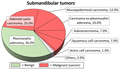 Relative incidence of submandibular tumors

_HE_stain.jpg)
_HE_stain.jpg)
_AB-PAS_stain.jpg)


Ad. Transform your life with W8MD's
GLP-1 weight loss injections special from $29.99 with insurance
|
WikiMD Medical Encyclopedia |
Medical Disclaimer: WikiMD is for informational purposes only and is not a substitute for professional medical advice. Content may be inaccurate or outdated and should not be used for diagnosis or treatment. Always consult your healthcare provider for medical decisions. Verify information with trusted sources such as CDC.gov and NIH.gov. By using this site, you agree that WikiMD is not liable for any outcomes related to its content. See full disclaimer.
Credits:Most images are courtesy of Wikimedia commons, and templates, categories Wikipedia, licensed under CC BY SA or similar.
Translate this page: - East Asian
中文,
日本,
한국어,
South Asian
हिन्दी,
தமிழ்,
తెలుగు,
Urdu,
ಕನ್ನಡ,
Southeast Asian
Indonesian,
Vietnamese,
Thai,
မြန်မာဘာသာ,
বাংলা
European
español,
Deutsch,
français,
Greek,
português do Brasil,
polski,
română,
русский,
Nederlands,
norsk,
svenska,
suomi,
Italian
Middle Eastern & African
عربى,
Turkish,
Persian,
Hebrew,
Afrikaans,
isiZulu,
Kiswahili,
Other
Bulgarian,
Hungarian,
Czech,
Swedish,
മലയാളം,
मराठी,
ਪੰਜਾਬੀ,
ગુજરાતી,
Portuguese,
Ukrainian
