Posterior cruciate ligament
Posterior Cruciate Ligament
The Posterior Cruciate Ligament (PCL) is one of the four major ligaments of the knee. It originates from the posterior intercondylar area of the tibia and inserts into the medial condyle of the femur. This ligament is responsible for preventing the tibia from sliding backwards under the femur.
Anatomy[edit]
The PCL is located within the knee. It connects the femur to the tibia. The ligament is named for its posterior insertion on the tibial plateau.
Function[edit]
The primary functions of the PCL is to prevent posterior translation of the tibia on the femur. The PCL is also important in controlling the amount of tibial external and internal rotation.
Clinical significance[edit]
Injury to the PCL can occur as a result of direct impact, such as in an automobile accident, or during sports when an athlete falls on a bent knee with the foot pointed down. The ligament can also be injured by a direct blow to the front of the knee.
Treatment[edit]
Treatment for PCL injuries includes rest, ice, and elevation. Nonsteroidal anti-inflammatory drugs (NSAIDs) may also be used to help reduce pain and swelling. In severe cases, surgery may be required to repair or reconstruct the PCL.
See also[edit]
 | |
|---|---|
 |
 |
-
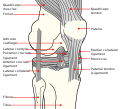 Diagram of the knee joint
 -
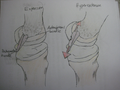 PCL during extension and hyperextension
 -
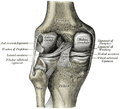 Anatomy of the knee joint
 -
 PCL during flexion and hyperflexion
 -
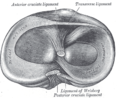 Ligaments of the knee
 -
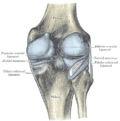 Sagittal section of the knee joint
 -
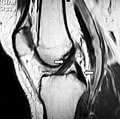 MRI of ACL and PCL
 -
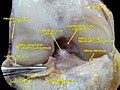 Posterior cruciate ligament
 -
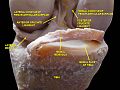 Posterior cruciate ligament


Ad. Transform your health with W8MD Weight Loss, Sleep & MedSpa

Tired of being overweight?
Special offer:
Budget GLP-1 weight loss medications
- Semaglutide starting from $29.99/week and up with insurance for visit of $59.99 and up per week self pay.
- Tirzepatide starting from $45.00/week and up (dose dependent) or $69.99/week and up self pay
✔ Same-week appointments, evenings & weekends
Learn more:
- GLP-1 weight loss clinic NYC
- W8MD's NYC medical weight loss
- W8MD Philadelphia GLP-1 shots
- Philadelphia GLP-1 injections
- Affordable GLP-1 shots NYC
|
WikiMD Medical Encyclopedia |
Medical Disclaimer: WikiMD is for informational purposes only and is not a substitute for professional medical advice. Content may be inaccurate or outdated and should not be used for diagnosis or treatment. Always consult your healthcare provider for medical decisions. Verify information with trusted sources such as CDC.gov and NIH.gov. By using this site, you agree that WikiMD is not liable for any outcomes related to its content. See full disclaimer.
Credits:Most images are courtesy of Wikimedia commons, and templates, categories Wikipedia, licensed under CC BY SA or similar.
Translate this page: - East Asian
中文,
日本,
한국어,
South Asian
हिन्दी,
தமிழ்,
తెలుగు,
Urdu,
ಕನ್ನಡ,
Southeast Asian
Indonesian,
Vietnamese,
Thai,
မြန်မာဘာသာ,
বাংলা
European
español,
Deutsch,
français,
Greek,
português do Brasil,
polski,
română,
русский,
Nederlands,
norsk,
svenska,
suomi,
Italian
Middle Eastern & African
عربى,
Turkish,
Persian,
Hebrew,
Afrikaans,
isiZulu,
Kiswahili,
Other
Bulgarian,
Hungarian,
Czech,
Swedish,
മലയാളം,
मराठी,
ਪੰਜਾਬੀ,
ગુજરાતી,
Portuguese,
Ukrainian
