Plantago
Plantago is a genus of about 200 species of small, inconspicuous plants commonly known as plantains or fleaworts. The common name plantain is shared with the unrelated cooking plantain, a kind of banana. Most species are native to Europe, Asia, and North America, but they are found worldwide.
Description[edit]
Plantago species are perennial herbs with basal or alternate leaves and inconspicuous flowers characterized by their dense, spike inflorescence. The flowers are wind-pollinated, and the seeds, which are contained in a small capsule, are primarily dispersed by human activities and to a lesser extent by water and wind.
Taxonomy[edit]
The genus Plantago was first described by Carl Linnaeus in 1753. It belongs to the family Plantaginaceae, the plantain family. The genus is divided into four subgenera: Plantago, Coronopus, Albicans, and Bougueria. The species are difficult to distinguish, and the number of species is disputed, with estimates ranging from 200 to 250.
Uses[edit]
Plantago species have been used since ancient times for their medicinal properties. They are a rich source of flavonoids, lignans, and terpenoids, which have antioxidant, anti-inflammatory, and antimicrobial activities. The leaves of Plantago major, the common plantain, are used in traditional medicine for the treatment of wounds, insect bites, and skin disorders. The seeds of Plantago ovata, the desert Indianwheat, are used as a dietary fiber supplement.
Cultivation[edit]
Plantago species are easy to grow and are often considered weeds. They prefer full sun or partial shade and can tolerate a wide range of soil conditions, including poor, dry, or sandy soils. They are propagated by seeds, which can be sown directly in the garden in spring or started indoors in late winter.
Conservation[edit]
Several Plantago species are threatened by habitat loss and overharvesting. Conservation efforts include habitat protection, sustainable harvesting practices, and ex situ conservation in seed banks and botanical gardens.
See also[edit]


-
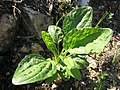 Plantago major
 -
 Plantago alpina
 -
 Plantago lanceolata
 -
 Ribwort plantain
 -
 Plantago nivalis
 -
 Ribwort flower spike
 -
 Plantago coronopus
 -
 Plantago media
 -
 Plantago maritima


Ad. Transform your health with W8MD Weight Loss, Sleep & MedSpa

Tired of being overweight?
Get started with evidence based, physician-supervised
affordable GLP-1 weight loss injections
Now available in New York City and Philadelphia:
- Semaglutide starting from $59.99/week and up
- Tirzepatide starting from $69.99/week and up (dose dependent)
✔ Evidence-based medical weight loss ✔ Insurance-friendly visits available ✔ Same-week appointments, evenings & weekends
Learn more:
Start your transformation today with W8MD weight loss centers.
|
WikiMD Medical Encyclopedia |
Medical Disclaimer: WikiMD is for informational purposes only and is not a substitute for professional medical advice. Content may be inaccurate or outdated and should not be used for diagnosis or treatment. Always consult your healthcare provider for medical decisions. Verify information with trusted sources such as CDC.gov and NIH.gov. By using this site, you agree that WikiMD is not liable for any outcomes related to its content. See full disclaimer.
Credits:Most images are courtesy of Wikimedia commons, and templates, categories Wikipedia, licensed under CC BY SA or similar.
Translate this page: - East Asian
中文,
日本,
한국어,
South Asian
हिन्दी,
தமிழ்,
తెలుగు,
Urdu,
ಕನ್ನಡ,
Southeast Asian
Indonesian,
Vietnamese,
Thai,
မြန်မာဘာသာ,
বাংলা
European
español,
Deutsch,
français,
Greek,
português do Brasil,
polski,
română,
русский,
Nederlands,
norsk,
svenska,
suomi,
Italian
Middle Eastern & African
عربى,
Turkish,
Persian,
Hebrew,
Afrikaans,
isiZulu,
Kiswahili,
Other
Bulgarian,
Hungarian,
Czech,
Swedish,
മലയാളം,
मराठी,
ਪੰਜਾਬੀ,
ગુજરાતી,
Portuguese,
Ukrainian
