Phyllanthus
Phyllanthus is a genus of flowering plants in the family Phyllanthaceae. Traditionally, it was included in the family Euphorbiaceae, but genetic research has led to its reclassification. The genus is distributed in tropical and subtropical regions across the world, with a high diversity in the Americas and Africa. Phyllanthus comprises over 700 species, making it one of the largest genera of flowering plants. The plants in this genus display a wide range of growth forms, from small herbs to large shrubs and occasionally trees. Many species of Phyllanthus are known for their medicinal properties and have been used in various traditional medicine systems across the world.
Description[edit]
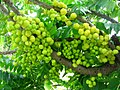
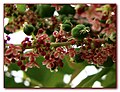
Phyllanthus species vary greatly in their appearance. They can be annual or perennial herbs, shrubs, or rarely small trees. The leaves are simple, arranged alternately along the stem, and often appear flattened. The flowers of Phyllanthus are small and inconspicuous, usually greenish or white, and can be either unisexual or bisexual. The fruit is a capsule that splits open when mature to release the seeds.
Taxonomy[edit]
The genus Phyllanthus was first described by Carl Linnaeus in 1753. The name Phyllanthus comes from the Greek words phyllon, meaning leaf, and anthos, meaning flower, referring to the leaf-like appearance of the flowers in some species. The taxonomy of Phyllanthus has been complex and controversial due to the genus's large size and morphological diversity. Molecular phylogenetic studies have helped clarify the relationships within the genus and with related genera.
Ecology[edit]
Phyllanthus species are found in a variety of habitats, including tropical rainforests, dry savannas, and even desert edges. They are adapted to a wide range of environmental conditions, which is reflected in the diverse ecological strategies observed within the genus. Some species are known to be pioneer species, colonizing disturbed areas and contributing to the ecological succession process.
Medicinal Uses[edit]
Several species of Phyllanthus are used in traditional medicine for their purported therapeutic properties. The most well-known among these is Phyllanthus niruri, also known as Chanca Piedra or Stone Breaker, which is used to treat kidney stones and liver ailments. Compounds extracted from Phyllanthus species have been studied for their potential antiviral, antimicrobial, anti-inflammatory, and anticancer activities. However, scientific evidence supporting these uses varies, and more research is needed to fully understand their efficacy and safety.
Selected Species[edit]
- Phyllanthus acidus – Otaheite gooseberry
- Phyllanthus amarus
- Phyllanthus emblica – Indian gooseberry, also known as Amla
- Phyllanthus niruri – Chanca Piedra or Stone Breaker
- Phyllanthus urinaria
Conservation[edit]
The conservation status of Phyllanthus species varies widely. While some species are common and widespread, others are rare and face threats from habitat destruction, overharvesting, and climate change. Conservation efforts are necessary to protect the vulnerable species and ensure the sustainability of traditional practices that depend on them.
See Also[edit]
References[edit]
<references/>

-
 Phyllanthus
 -
 Phyllanthus
 -
 Phyllanthus
 -
 Phyllanthus
 -
 Phyllanthus
 -
 Phyllanthus
 -
 Phyllanthus


Ad. Transform your life with W8MD's
GLP-1 weight loss injections special from $29.99


W8MD Medical Weight Loss, Sleep and Medspa offers physician-supervised medical weight loss programs: NYC medical weight loss Philadelphia medical weight loss
Affordable GLP-1 Weight Loss ShotsAffordable GLP-1 Weight Loss Shots
Budget GLP-1 injections NYC (insurance & self-pay options) Popular treatments:
- Semaglutide starting from $29.99/week
- Tirzepatide starting from $45.00/week
✔ Most insurances accepted for visits ✔ Prior authorization support when eligible
Start your physician weight loss NYC journey today:
📍 NYC: Brooklyn weight loss center 📍 Philadelphia: Philadelphia weight loss center
📞 Call: 718-946-5500 (NYC) | 215-676-2334 (Philadelphia)
Tags: Affordable GLP1 weight loss NYC, Wegovy NYC, Zepbound NYC, Philadelphia medical weight loss


|
WikiMD Medical Encyclopedia |
Medical Disclaimer: WikiMD is not a substitute for professional medical advice. The information on WikiMD is provided as an information resource only, may be incorrect, outdated or misleading, and is not to be used or relied on for any diagnostic or treatment purposes. Please consult your health care provider before making any healthcare decisions or for guidance about a specific medical condition. WikiMD expressly disclaims responsibility, and shall have no liability, for any damages, loss, injury, or liability whatsoever suffered as a result of your reliance on the information contained in this site. By visiting this site you agree to the foregoing terms and conditions, which may from time to time be changed or supplemented by WikiMD. If you do not agree to the foregoing terms and conditions, you should not enter or use this site. See full disclaimer.
Credits:Most images are courtesy of Wikimedia commons, and templates, categories Wikipedia, licensed under CC BY SA or similar.
Translate this page: - East Asian
中文,
日本,
한국어,
South Asian
हिन्दी,
தமிழ்,
తెలుగు,
Urdu,
ಕನ್ನಡ,
Southeast Asian
Indonesian,
Vietnamese,
Thai,
မြန်မာဘာသာ,
বাংলা
European
español,
Deutsch,
français,
Greek,
português do Brasil,
polski,
română,
русский,
Nederlands,
norsk,
svenska,
suomi,
Italian
Middle Eastern & African
عربى,
Turkish,
Persian,
Hebrew,
Afrikaans,
isiZulu,
Kiswahili,
Other
Bulgarian,
Hungarian,
Czech,
Swedish,
മലയാളം,
मराठी,
ਪੰਜਾਬੀ,
ગુજરાતી,
Portuguese,
Ukrainian
