Cellulose
Cellulose is the main chemical that forms the main structure of plants. It is the most abundant macromolecule on Earth. It is also a fibre.
Cellulose is made from a form of glucose and makes up most of the cell wall of plant cells. This is what keeps a plant in shape. Humans and other animals cannot digest cellulose but some animals such as termites and ruminants use bacteria to digest it.
It is a polysaccharide, which is repeating units of a monosaccharide joined together by a glycosidic bond by a condensation reaction, there is a by-product of water, found in plants. It is very tough because when you join beta glucose together, they are opposite ways up, the bonds are straight, forming straight chains. There is hydrogen bonds between the polymers.
These fibers are in bundles of about 40, called microfibrils. Microfibrils are embedded in a hydrated network of other polysaccharides. The cell wall is assembled in place. The parts are made inside the cell and then assembled by enzymes associated with the cell membrane.

-
 Cellulose molecular structure
 -
 Diagram of a plant cell wall
 -
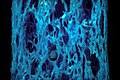 Sponge cloth side view
 -
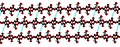 Cellulose space-filling model
 -
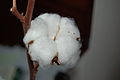 Cotton plant
 -
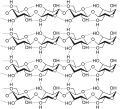 Cellulose strand


.jpg)


Ad. Transform your health with W8MD Weight Loss, Sleep & MedSpa

Tired of being overweight?
Special offer:
Budget GLP-1 weight loss medications
- Semaglutide starting from $29.99/week and up with insurance for visit of $59.99 and up per week self pay.
- Tirzepatide starting from $45.00/week and up (dose dependent) or $69.99/week and up self pay
✔ Same-week appointments, evenings & weekends
Learn more:
- GLP-1 weight loss clinic NYC
- W8MD's NYC medical weight loss
- W8MD Philadelphia GLP-1 shots
- Philadelphia GLP-1 injections
- Affordable GLP-1 shots NYC
|
WikiMD Medical Encyclopedia |
Medical Disclaimer: WikiMD is for informational purposes only and is not a substitute for professional medical advice. Content may be inaccurate or outdated and should not be used for diagnosis or treatment. Always consult your healthcare provider for medical decisions. Verify information with trusted sources such as CDC.gov and NIH.gov. By using this site, you agree that WikiMD is not liable for any outcomes related to its content. See full disclaimer.
Credits:Most images are courtesy of Wikimedia commons, and templates, categories Wikipedia, licensed under CC BY SA or similar.
Translate this page: - East Asian
中文,
日本,
한국어,
South Asian
हिन्दी,
தமிழ்,
తెలుగు,
Urdu,
ಕನ್ನಡ,
Southeast Asian
Indonesian,
Vietnamese,
Thai,
မြန်မာဘာသာ,
বাংলা
European
español,
Deutsch,
français,
Greek,
português do Brasil,
polski,
română,
русский,
Nederlands,
norsk,
svenska,
suomi,
Italian
Middle Eastern & African
عربى,
Turkish,
Persian,
Hebrew,
Afrikaans,
isiZulu,
Kiswahili,
Other
Bulgarian,
Hungarian,
Czech,
Swedish,
മലയാളം,
मराठी,
ਪੰਜਾਬੀ,
ગુજરાતી,
Portuguese,
Ukrainian
