Atoll
Atoll is a ring-shaped coral reef, island, or series of islets that encircle a lagoon, either partially or completely. Atolls are usually formed from the growth of coral reefs around a volcanic island that has subsided below sea level over millions of years. The process of atoll formation involves several stages, starting with a fringing reef forming around a volcanic island, followed by the island's erosion and subsidence, leaving a barrier reef with a central lagoon. Finally, the barrier reef may break into segments, forming an atoll with islets around a lagoon. Atolls are most commonly found in the warm waters of the Pacific Ocean and the Indian Ocean.
Formation[edit]
The formation of an atoll involves a complex interplay between coral growth, volcanic activity, and sea-level changes. The initial stage begins with a volcanic island, which emerges above the sea surface due to volcanic activity. Coral reefs start to grow in the shallow, warm waters around the island. Over time, the volcanic island erodes and subsides back into the sea, a process that can be accelerated by the weight of the growing coral reef. As the island subsides, the coral continues to grow upwards, maintaining its position close to the sea surface. This growth leads to the formation of a barrier reef enclosing a lagoon where the island once was. Eventually, the barrier reef may become segmented, forming an atoll.
Ecology[edit]
Atolls support a diverse range of marine life, making them significant for biodiversity. The lagoons provide a sheltered environment for various species of fish, invertebrates, and sea plants. The coral reefs themselves are home to a multitude of organisms, including coral polyps, which are the primary builders of the reef, and a wide array of fish, marine turtles, and other marine species. Atolls also serve as important bird habitats, especially for seabirds that may nest on the islets.
Human Impact[edit]
Human activity has had a significant impact on atolls. Climate change, leading to rising sea levels and increased ocean temperatures, poses a severe threat to atolls. The rising sea levels can lead to increased erosion of the islets, while higher temperatures can cause coral bleaching, a stress response in which corals expel the symbiotic algae living in their tissues, leading to a decline in coral health and the ecosystem's overall productivity. Additionally, pollution, overfishing, and destructive fishing practices further threaten atoll ecosystems.
Conservation[edit]
Efforts to conserve atolls and their ecosystems include establishing Marine Protected Areas (MPAs), implementing sustainable fishing practices, and conducting research to better understand atoll ecosystems and the impacts of climate change. Conservation initiatives also focus on restoring damaged reefs through coral transplantation and reducing global carbon emissions to mitigate climate change effects.
See Also[edit]

-
 Tetiaroa from the sky
 -
 On the structure and distribution of coral reefs
 -
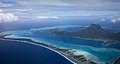 Bora Bora
 -
 South Tarawa from the air
 -
 Bikini Atoll
 -
 Wake Island


.jpg)


Ad. Transform your health with W8MD Weight Loss, Sleep & MedSpa

Tired of being overweight?
Special offer:
Budget GLP-1 weight loss medications
- Semaglutide starting from $29.99/week and up with insurance for visit of $59.99 and up per week self pay.
- Tirzepatide starting from $45.00/week and up (dose dependent) or $69.99/week and up self pay
✔ Same-week appointments, evenings & weekends
Learn more:
- GLP-1 weight loss clinic NYC
- W8MD's NYC medical weight loss
- W8MD Philadelphia GLP-1 shots
- Philadelphia GLP-1 injections
- Affordable GLP-1 shots NYC
|
WikiMD Medical Encyclopedia |
Medical Disclaimer: WikiMD is for informational purposes only and is not a substitute for professional medical advice. Content may be inaccurate or outdated and should not be used for diagnosis or treatment. Always consult your healthcare provider for medical decisions. Verify information with trusted sources such as CDC.gov and NIH.gov. By using this site, you agree that WikiMD is not liable for any outcomes related to its content. See full disclaimer.
Credits:Most images are courtesy of Wikimedia commons, and templates, categories Wikipedia, licensed under CC BY SA or similar.
Translate this page: - East Asian
中文,
日本,
한국어,
South Asian
हिन्दी,
தமிழ்,
తెలుగు,
Urdu,
ಕನ್ನಡ,
Southeast Asian
Indonesian,
Vietnamese,
Thai,
မြန်မာဘာသာ,
বাংলা
European
español,
Deutsch,
français,
Greek,
português do Brasil,
polski,
română,
русский,
Nederlands,
norsk,
svenska,
suomi,
Italian
Middle Eastern & African
عربى,
Turkish,
Persian,
Hebrew,
Afrikaans,
isiZulu,
Kiswahili,
Other
Bulgarian,
Hungarian,
Czech,
Swedish,
മലയാളം,
मराठी,
ਪੰਜਾਬੀ,
ગુજરાતી,
Portuguese,
Ukrainian
