Herbert Spencer
Herbert Spencer (27 April 1820 – 8 December 1903) was an English philosopher, biologist, anthropologist, sociologist, and prominent classical liberal political theorist of the Victorian era.
Early Life and Education[edit]
Spencer was born in Derby, England on 27 April 1820. His father, William George Spencer, was a schoolmaster, and his mother, Harriet Spencer, was a devotee of radical causes. Spencer was educated at home by his father and by his uncle, the Reverend Thomas Spencer, who introduced him to experimental science and influenced his early thinking.
Career[edit]
Spencer's career spanned a variety of fields, but he is best known for his work in philosophy and sociology. He developed an all-embracing conception of evolution as the progressive development of the physical world, biological organisms, the human mind, and human culture and societies. His major works include Principles of Psychology (1855), Principles of Biology (1864-7), and Principles of Sociology (1876-96).
Contributions to Medicine[edit]
While not a physician, Spencer's ideas have had a significant impact on the field of medicine. His concept of "survival of the fittest" has been used to explain the process of natural selection, and his theories on evolution have influenced the study of genetics and heredity.
Death and Legacy[edit]
Spencer died on 8 December 1903. His influence declined sharply after his death, but he continues to be recognized as a key figure in the development of the modern concept of evolution.

This article is a philosophy-related stub. You can help WikiMD by expanding it!


-
 Herbert Spencer
 -
 Grave of Herbert Spencer
 -
 Herbert Spencer by John Bagnold Burgess
 -
 Herbert Spencer
 -
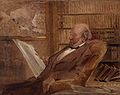 Herbert Spencer by John McLure Hamilton


Ad. Transform your life with W8MD's
GLP-1 weight loss injections special from $29.99 with insurance
|
WikiMD Medical Encyclopedia |
Medical Disclaimer: WikiMD is for informational purposes only and is not a substitute for professional medical advice. Content may be inaccurate or outdated and should not be used for diagnosis or treatment. Always consult your healthcare provider for medical decisions. Verify information with trusted sources such as CDC.gov and NIH.gov. By using this site, you agree that WikiMD is not liable for any outcomes related to its content. See full disclaimer.
Credits:Most images are courtesy of Wikimedia commons, and templates, categories Wikipedia, licensed under CC BY SA or similar.
Translate this page: - East Asian
中文,
日本,
한국어,
South Asian
हिन्दी,
தமிழ்,
తెలుగు,
Urdu,
ಕನ್ನಡ,
Southeast Asian
Indonesian,
Vietnamese,
Thai,
မြန်မာဘာသာ,
বাংলা
European
español,
Deutsch,
français,
Greek,
português do Brasil,
polski,
română,
русский,
Nederlands,
norsk,
svenska,
suomi,
Italian
Middle Eastern & African
عربى,
Turkish,
Persian,
Hebrew,
Afrikaans,
isiZulu,
Kiswahili,
Other
Bulgarian,
Hungarian,
Czech,
Swedish,
മലയാളം,
मराठी,
ਪੰਜਾਬੀ,
ગુજરાતી,
Portuguese,
Ukrainian
