Transmembrane protein
Transmembrane Protein[edit]

A transmembrane protein is a type of integral membrane protein that spans the entirety of the biological membrane to which it is permanently attached. These proteins are crucial for a variety of cellular processes, including signaling, transport, and maintaining the structure of the cell.
Structure[edit]
Transmembrane proteins typically have one or more alpha-helical segments that traverse the lipid bilayer. These segments are composed of hydrophobic amino acids that interact with the lipid tails of the membrane. Some transmembrane proteins may also contain beta-barrel structures, which are more common in the outer membranes of gram-negative bacteria, mitochondria, and chloroplasts.

Function[edit]
Transmembrane proteins serve a variety of functions:
- Transport: They act as channels or carriers for molecules to pass through the membrane. Examples include ion channels and transporters.
- Signal Transduction: They play a role in transmitting signals from the outside to the inside of the cell, often involving receptors that bind to specific ligands.
- Cell Adhesion: Some transmembrane proteins are involved in cell-cell adhesion, helping cells to stick to each other and to the extracellular matrix.
- Enzymatic Activity: Certain transmembrane proteins have enzymatic functions, catalyzing reactions at the membrane surface.
Types[edit]
Transmembrane proteins can be classified based on their topology and the number of times they span the membrane:
- Single-pass transmembrane proteins: These proteins cross the membrane only once.
- Multi-pass transmembrane proteins: These proteins have multiple segments that cross the membrane several times, often forming complex structures.
Synthesis and Insertion[edit]
The synthesis of transmembrane proteins occurs in the endoplasmic reticulum (ER). They are initially synthesized as polypeptide chains by ribosomes and then inserted into the ER membrane. The insertion process is facilitated by the translocon, a complex that helps guide the protein into the membrane.
Research and Applications[edit]
Transmembrane proteins are a major focus of research due to their roles in health and disease. They are targets for many drugs and are studied for their potential in biotechnology and nanotechnology.

Related Pages[edit]
References[edit]
-
 Polytopic membrane protein
 -
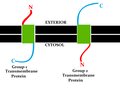 Group 1 and 2 transmembrane protein
 -
 Cumulative unique membrane protein structures by year
Ad. Transform your health with W8MD Weight Loss, Sleep & MedSpa

Tired of being overweight?
Special offer:
Budget GLP-1 weight loss medications
- Semaglutide starting from $29.99/week and up with insurance for visit of $59.99 and up per week self pay.
- Tirzepatide starting from $45.00/week and up (dose dependent) or $69.99/week and up self pay
✔ Same-week appointments, evenings & weekends
Learn more:
- GLP-1 weight loss clinic NYC
- W8MD's NYC medical weight loss
- W8MD Philadelphia GLP-1 shots
- Philadelphia GLP-1 injections
- Affordable GLP-1 shots NYC
|
WikiMD Medical Encyclopedia |
Medical Disclaimer: WikiMD is for informational purposes only and is not a substitute for professional medical advice. Content may be inaccurate or outdated and should not be used for diagnosis or treatment. Always consult your healthcare provider for medical decisions. Verify information with trusted sources such as CDC.gov and NIH.gov. By using this site, you agree that WikiMD is not liable for any outcomes related to its content. See full disclaimer.
Credits:Most images are courtesy of Wikimedia commons, and templates, categories Wikipedia, licensed under CC BY SA or similar.
Translate this page: - East Asian
中文,
日本,
한국어,
South Asian
हिन्दी,
தமிழ்,
తెలుగు,
Urdu,
ಕನ್ನಡ,
Southeast Asian
Indonesian,
Vietnamese,
Thai,
မြန်မာဘာသာ,
বাংলা
European
español,
Deutsch,
français,
Greek,
português do Brasil,
polski,
română,
русский,
Nederlands,
norsk,
svenska,
suomi,
Italian
Middle Eastern & African
عربى,
Turkish,
Persian,
Hebrew,
Afrikaans,
isiZulu,
Kiswahili,
Other
Bulgarian,
Hungarian,
Czech,
Swedish,
മലയാളം,
मराठी,
ਪੰਜਾਬੀ,
ગુજરાતી,
Portuguese,
Ukrainian
