Phyletic gradualism
Phyletic Gradualism is a model in evolutionary biology that proposes that most species' evolution occurs at a slow and steady pace rather than by the rapid bursts of change proposed by the punctuated equilibrium model. This concept is rooted in the ideas of Charles Darwin, who suggested that evolution proceeds via the accumulation of small, gradual changes over long periods of time.
Overview[edit]
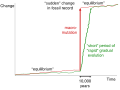
Phyletic gradualism posits that significant evolutionary changes occur through the accumulation of many small, incremental changes over long periods. This model contrasts with punctuated equilibrium, which suggests that evolution is characterized by long periods of evolutionary stasis interrupted by short, rapid periods of significant change. Phyletic gradualism implies that the fossil record should show a smooth and continuous flow of evolutionary changes, with transitional forms linking all species.
Historical Background[edit]
The concept of phyletic gradualism has its roots in the work of Charles Darwin, particularly in his seminal book, On the Origin of Species. Darwin argued that the mechanism of natural selection acts slowly and gradually, accumulating slight, successive changes in populations over millions of years, leading to the evolution of new species.
Criticism and Debate[edit]
Phyletic gradualism has been subject to criticism and debate within the scientific community. Critics argue that the fossil record often shows a pattern of abrupt appearances and disappearances of species rather than the gradual transitions predicted by phyletic gradualism. This criticism led to the development of the punctuated equilibrium model by Stephen Jay Gould and Niles Eldredge in the 1970s, which challenges the gradualist view by suggesting that evolution is more about equilibrium and sudden changes.
Implications for the Fossil Record[edit]
According to phyletic gradualism, the fossil record should exhibit a series of transitional forms, gradually leading from ancestral species to their descendants. However, the incompleteness of the fossil record and the rarity of preservation conditions that allow for the fossilization of transitional forms have made it difficult to find continuous evidence supporting this model.
Current Views[edit]
Today, the debate between phyletic gradualism and punctuated equilibrium is seen as more of a false dichotomy. Most evolutionary biologists recognize that evolution can occur through both gradual changes and in rapid bursts, depending on the environmental conditions and the evolutionary pressures facing a particular population. The consensus is that both models contribute to our understanding of the evolutionary process.
See Also[edit]
- Evolution
- Natural selection
- Fossil record
- Charles Darwin
- Punctuated equilibrium
- Stephen Jay Gould
- Niles Eldredge

-
 Phyletic gradualism
 -
 Phyletic gradualism


Ad. Transform your health with W8MD Weight Loss, Sleep & MedSpa

Tired of being overweight?
Special offer:
Budget GLP-1 weight loss medications
- Semaglutide starting from $29.99/week and up with insurance for visit of $59.99 and up per week self pay.
- Tirzepatide starting from $45.00/week and up (dose dependent) or $69.99/week and up self pay
✔ Same-week appointments, evenings & weekends
Learn more:
- GLP-1 weight loss clinic NYC
- W8MD's NYC medical weight loss
- W8MD Philadelphia GLP-1 shots
- Philadelphia GLP-1 injections
- Affordable GLP-1 shots NYC
|
WikiMD Medical Encyclopedia |
Medical Disclaimer: WikiMD is for informational purposes only and is not a substitute for professional medical advice. Content may be inaccurate or outdated and should not be used for diagnosis or treatment. Always consult your healthcare provider for medical decisions. Verify information with trusted sources such as CDC.gov and NIH.gov. By using this site, you agree that WikiMD is not liable for any outcomes related to its content. See full disclaimer.
Credits:Most images are courtesy of Wikimedia commons, and templates, categories Wikipedia, licensed under CC BY SA or similar.
Translate this page: - East Asian
中文,
日本,
한국어,
South Asian
हिन्दी,
தமிழ்,
తెలుగు,
Urdu,
ಕನ್ನಡ,
Southeast Asian
Indonesian,
Vietnamese,
Thai,
မြန်မာဘာသာ,
বাংলা
European
español,
Deutsch,
français,
Greek,
português do Brasil,
polski,
română,
русский,
Nederlands,
norsk,
svenska,
suomi,
Italian
Middle Eastern & African
عربى,
Turkish,
Persian,
Hebrew,
Afrikaans,
isiZulu,
Kiswahili,
Other
Bulgarian,
Hungarian,
Czech,
Swedish,
മലയാളം,
मराठी,
ਪੰਜਾਬੀ,
ગુજરાતી,
Portuguese,
Ukrainian
